Showing posts with label Insects. Show all posts

Andalucia – Day 7 Sierra de las Nieves and Gaucin

Sat 31 May 2014

Sierra de las Nieves

As this was our last day in Spain, we decided to have a shorter day so that we could do some sight-seeing in Gaucin in the afternoon. We drove about 30km to the north-east to Sierra de las Nieves Natural Park. This is high up in the mountains; all of today’s birding was above 1,000m.

Our first stop was at an open picnic area near the entrance to the park. The first sighting was of a Hoopoe as we parked the car. Great tit and Long-tailed tit were a couple of common species that we had not ticked as yet this week. A Cuckoo called from the forest, and after a few moments searching we managed to get a view of it in our ‘scopes. A stone drinking trough was attracting many birds down to drink, notably Spotted flycatcher and Crested tit.

We drove on further into the park until the track became too rough for our hired Seat Altea to go any further. We continued on foot, firstly through woodland, and then through more open, rocky terrain. Blackcap, Robin and Bonelli’s warbler were singing and a fine Subalpine warbler showed well to David and me. A Griffon vulture and a Booted eagle glided over and at last we found a Peregrine. In some flatter heathland near a farmstead were Linnet, Corn bunting, Stonechat and Northern wheatear. Fledgling Dartford warblers sat on a wire fence begging food from their parents.

The track lead us higher into pine forest where we stopped by a small stream hoping to see birds coming down to drink. In the tall pines we found Firecrest, Nuthatch, Coal tit and, soaring over the canopy, our only Sparrowhawk of the trip.

Retracing our steps back to the car we saw the stonechats and Dartford warblers again, along with Melodious and Spectacled warblers. We drove back to the picnic area and had lunch at one of the tables.

On the drive home we stopped at the cafe high on the Ronda road again, hoping to see some eagles. All we managed to spot were a Short-toed eagle and Griffon vulture in the far distance.

Gaucin

Back in Gaucin the three of us wandered up to Castillo del Aguila (Eagle Castle) in the late afternoon sunshine. This medieval castle sits on a promontory above the village and we enjoyed magnificent views of the village and surrounding mountains, and down towards Gibraltar and the coast 40km away.  A nice relaxing way to end our birding tour of Andalucia.

See also Bob’s Wingspan blog for Day 7.

Today’s List

 
Griffon Vulture Eurasian Sparrowhawk
Booted Eagle Peregrine
Woodpigeon Cuckoo
Swift Hoopoe
Woodchat Shrike Jay
Red-billed Chough Coal Tit
Crested Tit Great Tit
Blue Tit Wood Lark (h)
Long-tailed Tit Western Bonelli’s Warbler
Melodious Warbler Blackcap (h)
Dartford Warbler Spectacled Warbler
Subalpine Warbler Firecrest
Wren Blackbird
Robin Stonechat
Northern Wheatear Black Wheatear
Spotted Flycatcher Chaffinch
Goldfinch Linnet
Corn Bunting Cirl Bunting
36 Species  
 
Click here for the week’s full list
            

This is the list of butterflies we saw during the week (compiled by Alan Strachan).

Scarce Swallowtail Large White
Small White Bath White
Clouded Yellow Berger’s Clouded Yellow
Black Veined White Cleopatra
Small Copper Lang’s Short-tailed Blue
Brown Argus Monarch
Painted Lady Grayling
Meadow Brown Gate Keeper
Spanish Gatekeeper Small Heath
Speckled Wood Wall Brown
Southern Gatekeeper Common Blue
Small Skipper Rock Grayling
Spanish Marbled White Red Underwing Skipper
Knapweed Fritillary Moroccan Orange-tip
Sage Skipper Large Tortoiseshell
Lulworth Skipper Queen of Spain Fritillary
Marsh Fritillary Dusky Meadow Brown
Dusky Heath Holly Blue
Brimstone Large Skipper
Small Tortoiseshell Adonis Blue
Spanish Chalk Hill Blue Silver Studded Blue
42 Species  

Andalucia – Day 6 Around Jerez de la Frontera

Fri 30 May 2014

We travelled about 100km west today to explore the area around Jerez de la Frontera. We noted a dozen or so species as we travelled, including Glossy ibis, Black kite and Raven (any large black corvid is almost certainly a raven as carrion crow and rook are absent from this region). A Sardinian warbler darted across the road in front of the car, an unfortunate habit that leads to the demise of many.

Laguna de Medina Natural Park

We arrived just after 9.00 am and began a walk on a boardwalk/cycle track along the southern edge of the lake, leading eventually to a nice hide overlooking this large (120ha) body of water. We found a good selection of warblers (Reed, Great reed, Cetti’s, Melodious, Sardinian, Zitting cisticola) in the reeds and trees along the track. Bob glimpsed a Penduline tit, but despite standing and searching for some time, it never showed again. On the lake itself were Great crested grebe, Little grebe, Mallard and Pochard.  From the hide we had very distant views of Night herons and a Purple swamphen in the vegetation on the far side of the lake. A Purple heron flew over.

As we drove away to our next port of call another ocelated lizard ran across the road in front of us. Whilst driving on to Laguna Juncosa we kept a particular eye our for Magpie as they are rare in this corner of Spain. We spotted one on top of a roadside telegraph pole.

Laguna Juncosa

We stayed here for just twenty minutes as there was not a great deal of birdlife about. The two best were a male Montagu’s harrier and a Tawny pipit. Black-winged stilt, Black-tailed godwit, Ringed plover, Swift, Mallard, Little grebe, Shelduck and Zitting cisticola made up the rest of the list.

Salinas de Bonanza (Bonanza Saltpans)

The shallow evaporation ponds held good number of Greater flamingo, as well as a few Avocet, Sanderling, Kentish plover and Ringed plover. An elegant new gull species for me was the Slender-billed variety.

We pulled up by a small pumping station in a corner of one of the lagoons where we ate our picnic lunch and watched a Little tern hovering low over the water and plunging to catch fish. A Little egret posed for photographs nearby and a Slender-billed gull also floated on the water close to us. Glossy ibis and Flamingo treated us to a fly past.


Laguna Tarelo

Only a stone’s throw from our previous stop, this lake held some interesting birds. A good selection of ducks – Pochard, Red-crested pochard, Mallard, Gadwall and White-headed. On an island in the lake were Spoonbill, Little and Cattle egrets and Squacco herons. Several young Squacco herons (probably from more than one family) scrambled in the vegetation begging food from the adults. An interesting insect on the wire fence was a Migratory grasshopper. A male Little bittern perched in the trees across the lake showed well for a couple of minutes before flying off and disappearing. Best of all were a few Marbled ducks swimming in and out of view amongst the lakeside vegetation. We eventually counted a total of eight. Others were Coot, Moorhen, Little grebe, Yellow-legged gull and and overflying pale morph Booted eagle.

Pinar del la Algaida

We drove through this umbrella pine forest but saw little. A ten-minute stop only produced a Spotted flycatcher and Sardinian warbler. Griffon vulture and several Black kites soared over the canopy of trees, amongst them a solitary Red kite - the only one we saw during the week.


Trabujena Salt Marsh

Our final site before beginning the long journey back to Gaucin. We drove slowly through this area, specifically to find Lesser short-toed lark. I spotted a Purple swamphen sat on the bank of a small pond by some farm buildings that Bob dismissed as a chicken! As we passed and Bob got a better view he conceded that it was a Purple swamphen – the best view I had of one during the week. As we drove slowly along the track we saw only Crested larks and Yellow wagtails. A Back kite perched on a fence post and a Woodchat shrike on the wire. A large flock of Black-tailed godwit and good numbers of Avocet were across the marsh. We failed to find any Lesser short-toed lark.

In the late evening relaxing on the roof terrace we watched many swift, and the odd pallid swift, screaming over the roof tops of Gaucin, and of course, the pair of blue rock thrush.

See also Bob’s Wingspan blog of Day 6.

Today’s List

 
Shelduck Gadwall
Mallard Marbled Duck
Red-crested Pochard Pochard
White-headed Duck Little Grebe
Great Crested Grebe Greater Flamingo
White Stork Glossy Ibis
Eurasian Spoonbill Little Bittern
Black-crowned Night Heron Squacco Heron
Cattle Egret Grey Heron
Purple Heron Little Egret
Red Kite Black Kite
Griffon Vulture Marsh Harrier
Montagu’s Harrier Booted Eagle
Common Kestrel Purple Swamphen
Moorhen Eurasian Coot
Black-winged Stilt Pied Avocet
Ringed Plover Kentish Plover
Black-tailed Godwit Sanderling
Collared Pratincole Slender-billed Gull
Yellow-legged Gull Lesser Black-backed Gull
Little Tern Turtle Dove
Collared Dove Swift
Pallid Swift Hoopoe
Woodchat Shrike Jay
Common Magpie Jackdaw
Common Raven Penduline Tit (Bob only)
Crested Lark Red-rumped Swallow
Cetti’s Warbler Great Reed Warbler
Reed Warbler Melodious Warbler
Zitting Cisticola Sardinian Warbler
Spotless Starling Nightingale
Stonechat Blue Rock Thrush
Spotted Flycatcher Yellow Wagtail
Tawny Pipit Greenfinch
Goldfinch Corn Bunting
70 Species  

Andalucia – Day 4 La Janda

Wed 28 May 2014

We travelled south-west today for some lower-level birding away from the mountains. The day started wet and windy, but it did improve later.

Marchenilla Track, Near San Pablo

This dusty country road is only 10km from Gaucin and was visited specifically for Rufous bush robin and Tawny pipit. We spotted two Little owls en-route and, more excitingly, a couple of Black-winged kite flew across the road in front of us. Sadly not a great view, we only really saw the birds in silhouette gliding with their wings held in their characteristic deep V-shape.

After parking the car we began a gentle walk along the track and it wasn’t long before the target Rufous bush robin appeared. What a cracker, and our luck got even better when a second bird showed. An unusual looking sparrow sat on a fence caught my eye. Bob identified it as an Italian sparrow; a Spanish/house sparrow hybrid, considered by some authorities as a separate species.

A bit further along we found our second target species, Tawny pipit. This also afforded us good views from its perch on electricity wires. A small flock of Bee-eaters could be seen in a tree across the fields, and a fine Melodious warbler showed on a fence. Notable birds that did a fly past were Short-toed eagle, dark morph Booted eagle, Buzzard and White stork.

Tarifa – Playa de los Lances

We had to put on our waterproofs here as it was raining as we parked up. As we walked along the boardwalk out to the beach front hide Short-toed lark performed their short song flights, but there was not much else about on the beach, only a few Yellow-legged gull, Ringed plover, Kentish plover, Dunlin and Little egret. After twenty minutes we gave up because of the horrible weather and went for a coffee in a nearby hotel.

La Janda

It continued to rain quite heavily as we drove on to La Janda, but the worst had passed by the time we arrived. This is a large wetland area, but much of it has been “improved” for rice growing. We drove slowly along a track with flooded fields on either side. Lots of Cattle and Little egrets, Glossy ibis and White stork. We got out of the car to scan across an area of water with our ‘scopes and added Night heron, Spoonbill, some distant Collared pratincole and an even more distant Marsh harrier. An Egyptian mongoose ran across the track in front of us.

The road turned right to continue in a straight line for a few hundred metres. The white poplar trees along the left hand side were full of nesting Cattle egrets – hundreds of them. The car became a mobile hide allowing us great close views of them. Many Glossy ibis were also nesting amongst the egrets . A fantastic sight!


Once beyond the egret/ibis colony we stopped to eat our sandwiches, the rain having now cleared away. Reed and Cetti’s warblers were singing from somewhere in the bushes and Turtle doves sat on wires.

We drove onwards until we arrived at a few farm buildings were we stopped to look at half-a-dozen Black kites soaring low over the farm. As we continued through the farm a Little owl sat very photogenicly on a gate post. We followed the track for another two or three kilometres past more lagoons and finally to a woodland where a pair of Spanish Imperial eagles are breeding, but no sign of them above the trees. We turned the car around and began to retrace our route. A group of large birds high to our left caught our attention. We stopped to check them out and amongst the Griffon vultures were two Spanish Imperial eagles. An exciting find.

As we drove back through the farm the Little owl was back on its perch and obligingly allowed us to take more photographs. We followed the track back past the Cattle egret/Glossy ibis and finally out onto the main road. An ocelated lizard (one of the larger species) scuttled across the track at the end of the track.

Vejer de la Frontera

We called into this small town specifically to see the nesting colony of Bald ibis on rocky cliffs right next to the road. There were several well grown youngsters in the nests as well as the adults. But my, what an ugly bird!

Barbate Marshes

A large shallow lagoon near the coast that held Kentish plover, Spoonbill, Black-winged stilt, Lesser black-backed gull, Yellow-legged gull, Grey plover, Greater flamingo, Avocet and Little tern. We had excellent close views of Collared pratincole as they stood on the sandy track. Calandra lark, Stone curlew, Short-toed lark, Crested lark and Yellow wagtail (blue headed variety) were nice species in the surrounding grassland.

Mirador del Estrecho (Near Tarifa)

We stopped at this viewpoint to check if any late migrants were flying in from Africa. We did not see any, but the views across the Straits of Gibraltar to Morocco were very impressive.

Gaucin

Ended the day being serenaded by the Blue rock thrush singing from the rooftops of Gaucin.

See also Bob’s Wingspan Blog for Day 4.

Today’s List

 
Pheasant Mallard
Greater Flamingo White Stork
Northern Bald Ibis Glossy Ibis
Eurasian Spoonbill Black-crowned Night Heron
Cattle Egret Grey Heron
Little Egret Black-winged Kite
Black Kite Griffon Vulture
Short-toed Eagle Marsh Harrier
Common Buzzard Spanish Imperial Eagle
Booted Eagle Common Kestrel
Moorhen Stone-curlew
Black-winged Stilt Pied Avocet
Grey Plover Ringed Plover
Kentish Plover Dunlin
Collared Pratincole Yellow-legged Gull
Lesser Black-backed Gull Little Tern
Turtle Dove Little Owl
Swift European Bee-eater
Great Spotted Woodpecker Woodchat Shrike
Jackdaw Calandra Lark
Short-toed Lark Crested Lark
Skylark Barn Swallow
House Martin Cetti’s Warbler (h)
Reed Warbler Melodious Warbler
Zitting Cisticola Sardinian Warbler
Blackbird Nightingale
Rufous Bush Robin Stonechat
Blue Rock Thrush House Sparrow
Italian Sparrow Yellow Wagtail
Tawny Pipit Serin
Greenfinch Goldfinch
Linnet Corn Bunting
64 Species  

Andalucia – Day 3 Mountains South-west of Ronda

Tues 27 May 2014

We headed off towards Ronda for today’s birding. A short stop to check out a Rock sparrow sat on the roadside wall also produced a Subalpine and Melodious warbler. At a second stop we found a Black wheatear high up on the crags above the road and a Red-rumped swallow swooped below us.


Encinas Borraches Track

The track at Encinas Borraches was the first planned location. Bob intended this to be a visit of about an hour, but it we found such good birds here, we ended up staying for three. 

Both Crested and Thekla lark were bagged before we had even opened the gate to start walking the track. A few minutes scanning the area near to the farm buildings/pond produced Stonechat, Corn bunting and Little owl, but no sign of Southern grey shrike that Bob expected to find here. Red deer were high up on the rocky hillside.

A Black-eared wheatear was the first of several new species for me – a very fine looking bird. The sweet song of a Woodlark caught our attention, but it was some time before we eventually spotted the bird. A Cuckoo called from somewhere further down the valley and a Woodchat shrike perched in the top of shrubs. More mundane birds were Stonechat and Red-legged partridge. Black-veined white and Sage skipper butterflies excited Alan. The next new tick for me was Spectacled warbler; not just one, but a family party flitting around in some low shrubs. As we continued along the track two more warbler species were heard and eventually seen after some patient waiting - a Western Orphean warbler (another new tick for me) and Subalpine warbler. A Western Bonelli’s warbler was the last bird added before we turned to walk back. Golden oriole and Hoopoe were heard but not seen.


As we walked back David spotted a bird sat on a distant pylon which at first we thought was a Blue rock thrush, but once we had it in our ‘scopes we realised it was a Rock thrush - the find of the day. Nearing the car we at last found the Southern grey shrike that had eluded us earlier. After scoffing our sandwiches back at the car an interesting assortment of butterflies that were finding something nutritious on a cow-pat by the gate caught our attention.

Ronda

We moved on and stopped for coffee at a high mountain road which was allegedly a good spot for eagles. We sat with coffee for half-an-hour but did not see any eagles.

Bob left us in Ronda for twenty minutes of sight-seeing at the bridge, from where we found Chough, Pallid swift, Lesser kestrel, Feral pigeons and admired the wonderful views.

Montejaque Cork Woods

We pressed on to a cork oak forest near Montejaque. Firecrest was the best find here, and a red deer paddling in a small lake, which soon took cover in the trees when it spotted us. We looked carefully for Treecreeper, but without success.


Llanos de Libar

We headed up into a high mountain valley at Serrania de Ronda/Llanos de Libar for the final birding of the day. Rock bunting was the target species. At the first place we stopped only for five minutes as it was very windy, seeing only Griffon vulture, Corn bunting, Goldfinch and Sardinian warbler.

We moved a little further and higher and found Blue rock thrush, Black redstart and a Spanish ibex that looked down on us from the summit of a mountain across the valley. A Short-toed eagle flew over, as did a Raven. As we drove back down the mountain road we found Rock sparrow and Linnet drinking at a tiny pond and Black-eared wheatear perched on a lichen covered rock. Rock bunting remained elusive.

Fine views of the local Blue rock thrush on the rooftops of Gaucin in the evening.

See also Bob’s Wingspan blog for Day 3.

Today’s List

 
Red-legged Partridge Griffon Vulture
Short-toed Eagle Lesser Kestrel
Common Kestrel Rock Dove / Feral Pigeon
Woodpigeon Cuckoo
Little Owl Swift
Pallid Swift Kingfisher
Hoopoe Southern Grey Shrike
Woodchat Shrike Golden Oriole
Red-billed Chough Common Raven
Crested Lark Thekla Lark
Wood Lark Barn Swallow
Red-rumped Swallow Western Bonelli’s Warbler
Melodious Warbler Western Orphean Warbler
Spectacled Warbler Subalpine Warbler
Firecrest Blackbird
Nightingale Black Redstart
Stonechat Black-eared Wheatear
Black Wheatear Rock Thrush
Blue Rock Thrush Spotted Flycatcher
House Sparrow Rock Sparrow
Chaffinch Serin
Goldfinch Linnet
Corn Bunting  
45 Species  

Andalucia – Day 2 South to Algeciras

Mon 26 May 2014

I awoke to the song of a Blue rock thrush, and once I had washed and shaved, I took a cup of tea out onto the roof terrace and saw this handsome thrush sat on a nearby chimney (starting the day with another new species for me).

Near Gaucin

After breakfast in Bob’s house we headed off for the first full day’s birding. We pulled off the road just outside Gaucin to look at some birds of prey that had caught our eye – three Honey buzzard on their northward migration. In the distance towards Gibraltar another large bird was picked out in binoculars. We thought it might be a Black stork, but we could not locate it again in our ‘scopes.

A little way further from Gaucin we spent a pleasant hour walking along a track by the shallow Rio Genal. More Honey buzzard were flying over as we began and we heard Nightingale and Turtle dove. Male and female Blackcaps showed well, and down by the water both Grey and White wagtails were seen. From the finch family we saw Chaffinch, Greenfinch and Serin and of warblers Sardinian and Cetti’s. We spent a while observing a couple of interesting butterflies. A Jay flew across the river and a Golden oriole, initially heard singing, eventually showed itself as it flew between trees. More birds of prey – Buzzard, Short-toed eagle and dark morph Booted eagle. The drumming of a Great spotted woodpecker came from not too far away and finally a Raven circled high above us.

River Guadiaro

We drove on, heading for the River Guadiaro, but we stopped a couple of times before getting there to see Crested lark, Woodchat shrike, another pale morph Booted eagle and possibly a Thekla lark.

At the River Guadiaro things were a little quiet. A Turtle dove and a Bee-eater sat close together on a wire in the distance on the other side of the river. A few Swallows made some low-level passes over the water and on the exposed shingle were one or two Little-ringed plover. Bob called an Alpine swift, but I am not sure if anyone else managed to spot it. A pale morph Booted eagle circled overhead giving some superb views. A Bath white butterfly was also a nice find. Goldfinch, Greenfinch, Corn bunting and Stonechat were added as we strolled back to the car, along with a fine female Sardinian warbler.

We moved a short distance to another spot on the same river, stopping en-route to try to get a better view of an Egyptian vulture. Unfortunately it disappeared behind a low hill not to be seen again.

The target species at this section of the river was Western Olivaceous warbler, as this was a known breeding site. Nightingale and Cetti’s were heard, and a small flock of Yellow-legged gulls lazed on a spit of shingle in the river. A likely scratchy warble from a low bush turned out to be a Sardinian warbler. Little egret, Common sandpiper and Little-ringed plover sat on the opposite bank of the river. After a some time searching we eventually found and had a good view of the Western Olivaceous warbler (listed as Isabelline warbler by some sources). Other species seen were Cirl bunting, Serin and White wagtail.

San Enrique Woods

We moved on to San Enrique Woods where we munched our sandwiches stood by the open boot of the car. Alan mentioned that that he would very much like to see a Wryneck, and no sooner had he said this than one began calling nearby. It almost immediately appeared and perched, continuing to call, above us. It moved back and forth between two trees, calling excitedly all the time, and allowing us great views. A griffon vulture cruised past and we found tree sparrows from the nearby breeding colony. A Monarch butterfly wafted around in a clearing. Once we had finished our lunch we walked a short distance into the deciduous wood, consisting mainly of white poplar. Here we saw jay, a family party of Spotted flycatcher, Chaffinch and White wagtail and heard Hoopoe and Great spotted woodpecker. We failed to find Short-toed treecreeper, though we thought we heard one.

Pinar del Rey Pinewoods

There were lots of White stork sitting in the nests on various poles and pylons as we travelled on to our next destination, Pinar del Rey pinewoods. Chaffinch, Blackcap and Bonelli’s warbler were heard and eventually spotted. Crested tit was another nice find. I located a small warbler whose song include phrases similar to a Chiffchaff, but with additional non-chiffchaff motifs. Bob identified this as an Iberian Chiffchaff. A scratchy warble that sounded a bit like a Whitethroat, though longer, was another Sardinian warbler. Finally, a Cleopatra butterfly was added to our insect list.

Polmones

The day’s last stop was at Polmones beach (near Algeciras). Not many species added here, but Kentish plover on a sand bar about 100m offshore was a good one. On the same sand bar were Black-headed and Yellow-legged gulls, Sandwich tern, Little plover and a blue-headed (Iberian race) Yellow wagtail.

On the journey back to Gaucin we stopped to look at a Lesser kestrel nest site in the structure of a railway bridge. One of the birds was on a telegraph wire, but it flew off as we drove past. We did see a couple of the birds in the distance, and one disappeared into the nest hole but did not not re-appear. A Melodious warbler showed briefly in the hedgerow.

See also Bob’s Wingspan blog for Day 2.

Today’s List

 
Mallard Little Grebe
White Stork Little Egret
European Honey Buzzard Egyptian Vulture
Griffon Vulture Short-toed Eagle
Common Buzzard Booted Eagle
Lesser Kestrel Common Kestrel
Moorhen Ringed Plover
Little Ringed Plover Kentish Plover
Common Sandpiper Black-headed Gull
Yellow-legged Gull Sandwich Tern
Woodpigeon Turtle Dove
Swift European Bee-eater
Hoopoe Wryneck
Great Spotted Woodpecker Woodchat Shrike
Golden Oriole Jay
Common Raven Crested Tit
Great Tit Blue Tit
Crested Lark Thekla Lark
Barn Swallow Cetti’s Warbler
Iberian Chiffchaff Western Bonelli’s Warbler
Western Olivaceous Warbler Melodious Warbler
Zitting Cisticola Blackcap
Sardinian Warbler Spotless Starling
Blackbird Robin
Nightingale Stonechat
Blue Rock Thrush Spotted Flycatcher
House Sparrow Tree Sparrow
Yellow Wagtail Grey Wagtail
White Wagtail Chaffinch
Serin Greenfinch
Goldfinch Corn Bunting
Cirl Bunting  
63 Species  

Andalucia – Day 1 Malaga and Gaucin

SUN 25 MAY 2014

After a early flight, Alan, David and I arrived at Malaga airport for a week’s bird watching in Andalucia, led by Bob Buckler of Wingspan Bird Tours. Once we had found Bob we all piled into his car and drove the short distance to an area of waste land near Guadalmar to get straight on with the birding.

Guadalmar

Target species were Hoopoe and Bee-eater, and both were found within a few minutes in the trees on the opposite side of the small river. Spotted flycatcher and Turtle dove were found in the same trees, and Barn swallow, House martin and the odd Red-rumped swallow swooped over the river. A new species for all of us was Monk parakeet – a non-native South American species. Alan noted a few butterflies including small skipper and clouded yellow, and a hummingbird hawk-moth was also spotted. Gulls were of the yellow-legged variety and Spotless starling, Swift, Crested lark, Jackdaw and Kestrel completed the list.

Guadalhorce Natural Park

We drove on a short distance to the Guadalhorce Natural Park, named after the river that flows on two sides of this triangle of land next to the Med. Collared dove and House sparrow were unspectacular starters for the list. On the water were Coot and Little grebe, and above, Whiskered tern patrolled along the river. From the bridge the unmistakable song of a Cetti’s warbler exploded in the air and the bird then flew a short distance along the river bank. The monotonous zip zip song of a Zitting cisticola punctured the air. A high point overlooking a shallow lagoon produced Spoonbill, Little egret and a couple of pairs of White-headed ducks. A Reed warbler was singing nearby. As we walked on towards another lagoon, more Bee-eaters and Monk parakeets flew over. From the screen at the next lagoon were added Black-winged stilt, Pochard, Yellow-legged gull and Gull-billed tern. Amongst the swifts chasing insects over the water was at least one Pallid swift. The final area of water produced Little tern, Avocet, Sanderling, Ringed plover, Dunlin, Whimbrel, Mallard and Red knot. As we made our way back to the car, final species bagged were Serin and Red-rumped swallow.

Crestellina and Gaucin

As it was now getting on for 3.00pm it was high time we made a start on the journey to the town of Gaucin; Bob’s home and our base for the trip. After an hour’s travelling, we turned-off the excellent A-7 onto the twisting and turning A-377 for the  20km climb up to Gaucin, nestled high (640m) in the mountains. We pulled up under the long ridge of Crestellina to watch the Griffon vultures soaring above the mountain. The distinctive chow call alerted us to the Red-billed chough  also present on the crags. A pair of Bonelli’s eagles breed on this mountain, but they were feared not to have been successful this year. Looking at the eyrie through our ‘scopes we were able to prove otherwise, as a large chick could clearly be seen patiently waiting for its parents to return. The adults were soaring around with the vultures, probably today’s star birds.

The road steepened and became more twisting as we got closer to Gaucin, and when at last we had finished the ascent and the town was spread in front of us a bird of prey caught our eye circling above the town. It had a snake in its talons so we pulled off the road to have a good look. A Short-toed eagle, of course, and as we watched it transferred the unfortunate reptile form its talons to its beak – no doubt destined to be a meal for its youngsters.

We had done little more than four hours birding since our arrival, but this had produced 48 species (including seven news ones for my life list), so a great start for our Spanish adventure.

See also Bob’s Wingspan blog for Day 1.

Today’s List

 
Mallard Pochard
White-headed Duck Little Grebe
Eurasian Spoonbill Little Egret
Griffon Vulture Short-toed Eagle
Bonelli's Eagle Common Kestrel
Eurasian Coot Black-winged Stilt
Pied Avocet Ringed Plover
Little Ringed Plover Whimbrel
Red Knot Sanderling
Dunlin Yellow-legged Gull
Gull-billed Tern Little Tern
Whiskered Tern Turtle Dove
Collared Dove Monk Parakeet
Swift Pallid Swift
European Bee-eater Hoopoe
Red-billed Chough Jackdaw
Crested Lark Barn Swallow
House Martin Red-rumped Swallow
Cetti’s Warbler Reed Warbler
Zitting Cisticola Spotless Starling
Blackbird Stonechat
Spotted Flycatcher House Sparrow
Serin Greenfinch
Goldfinch Corn Bunting
48 Species  

Hungary Day 5 – Exploring Hortobágy

Thurs 9 May 2013

No before breakfast excursion this morning, so no need to get up so early. I left my morning walk until 6.50 and just had a short (30 minute) stroll along the lane that lead uphill from the hotel entrance. The lane eventually opened out onto fields of grape vines. Nothing new to report, but a pair of red-backed shrikes were nice.

Psychiatric Hospital

After breakfast our first visit was to the woods surrounding a psychiatric hospital (I do not know the location). The sharp clicking call of a hawfinch led to the discoveryFemale Hawfinch near its nest of a pair attending to their nest. At last I managed to add woodpigeon to my list when one was spotted perched high on a dead tree. A woodpecker did not remain long enough to be identified – was it a great spotted or Syrian? Both Savi’s and river warblers were singing, and we spent a few minutes trying to locate the latter. Though it was probably no more than five metres away we could not find it.

Karcag

As we travelled south we stopped at a hotel in the small town of Karcag for our morning coffee. In fir trees in the adjacent park we were lucky enough to find a firecrest, another scarce species for Hungary.

A large fish farm 4 km south west of Karcag was our next destination. In only a short twenty minute visit we added several new species to our tally. Yellow-legged gull and teal were fairly run-of-the-mill but collared and black-winged pratincole were more exciting. These two species are incredibly difficult to tell apart, but we were confident that we had seen both as they flew over our heads. Roy was later able to confirm this when Sandor, the park ranger that we met earlier in the week, toldYellow wagtail (probably sub-species dombrowskii) at the fish farm near Karcag him that both species were present at this lake. A white-tailed eagle flew over in the distance (but close enough to see that it had one of its primary feathers missing). Stonechat, avocet, great egret, marsh harrier, mallard, grey heron, ringed plover (little?), and black-headed gull were also ticked. An interesting yellow wagtail with a white supercilium, dark grey ear coverts and a yellow throat was probably the Romanian sub-species dombrowskii.

Near Nádudvar

We moved on to the southern end of the Hortobágy National Park in the vicinity of White-winged black tern near Nádudvarthe village of Nádudvar (I am not sure of the exact location). We explored around the neighbourhood, occasionally stopping to see what was about. At one such stop a group of seven common crane were soaring high above and a red-footed falcon passed over. Steve found a hoopoe and a stonechat. We left the metalled road and continued on a dirt track.  Several ruff were close to the track, along with lapwing, purple heron and assorted marsh terns. 

The track led us to a derelict control tower, which suggested we were on an old
airfield, though I could not see evidence of any runways in the extensive wetlands that surrounded it. A reed filled ditch had many whiskered and white-winged terns patrolling along it that did not seem to be particularly bothered by our presence. A pair of black-necked grebe were diving for food on an area of open water and the deep booming of a bittern could be heard occasionally from somewhere close by. Steve photographed an interesting barn swallow with the usual white belly and chest showing as a rusty-red colour. We think it was probably the sub-species transitiva from the eastern Med/Levant, though it could have been savignii  from Egypt.
Barn Swallow (probably sub-species transitiva) photographed at the derelict control tower

We discovered that the bricked up entrance to the control tower had been broken open, which allowed us to climb a couple of flights of stairs and emerge onto a flat roof that gave us a great viewing platform (taking care not to go too close to the unguarded edge). There was an incredible number of great egrets – Peter stopped counting at 98! A bittern flew across, disappearing into the reeds, where a bit of a commotion ensued. Whether it was a scuffle with another male, or some interaction between a male and female, we could not tell. Three individuals were eventually seen.
Birdwatching from the roof of the derelict control tower Female red-backed shrike at the derelict control tower

Coot, cuckoo, reed bunting, purple heron, tree sparrow, greylag, marsh harrier, garganey and little grebe (a new bird for the list) were all seen as well. Great reed warbler and skylark were heard.

In the distance we could see a small lake that appeared to be worth investigatingBlack-necked grebe at the derelict control tower so we moved on to try and get a bit closer. Here we found pochard, corn bunting, black-winged stilt, white-winged tern, black-necked grebe and ferruginous duck. The fast, rippling call of a whimbrel was heard. A farmer on horse-back and his dogs were slowly driving a herd of cattle towards us – a pleasantly bucolic scene.

Journey Back

On the way back we called into a lake/wetland run by the Hortobágy Environmental Association. Time was pressing, so this was only to be a quick visit, but in the brief time we were here we found black-winged stilt, little ringed plover, and new species for the week,  common tern, shoveler and redshank.

Those travelling in Roy’s car had a fleeting glimpse of a moustached warbler as it flew across the road in front of them.

Giant Peacock moth on the wall of Hotel Villa Volgy, EgerBack at the hotel a huge moth that had been there in the morning was still on the wall of the hotel. It was a Giant Peacock Moth, Europe’s largest species and without doubt very impressive.

Additions today

Teal Shoveler
Little Grebe White-tailed Eagle
Crane Collared Pratincole
Black-winged Pratincole Whimbrel (h)
Redshank Yellow-legged Gull
Common Tern Moustached Warbler
Firecrest  
13 additions  

Brittany Apr-May 2011

(or Three go off to France to escape the royal wedding) 

Thu 28th April 2011

David, Steve and I decided to take the opportunity of the royal wedding/May day bank holidays to get in a few days bird watching in Brittany (and of course avoid the wall-to-wall coverage on every TV, radio and newspaper of the event). So Thursday evening found us waiting at Portsmouth for the 20.15 sailing of the Bretagne to St. Malo. Once on board we headed for the restaurant for a cup of tea and a snack, then went out on deck to watch as we sailed out of port. A relaxing pint in the lounge bar before heading to our cabin to turn-in.
 

Fri 29th April 2011

The ferry docked at 08:15 local time and we were soon on our way south. Our first destination was the Forêt de Rennes where we hoped to find various species of woodpecker. Nothing much seen en-route other than woodpigeon, starling and house martin. It took little more than an hour to get to our chosen spot in the forest – a point on the D528 where several tracks converge.
 
Exploring in the Foret de Rennes
The air was full with bird-song as we prepared to set off into the woods, and we had blackcap, chiffchaff, crested tit, and wood warbler before we had even moved from the car. A redstart was heard, but only Steve managed to get a sighting of it.

As we wandered through the woods birds were heard, but as is usually the case in woodland, they were difficult to see. I thought I heard and glimpsed a willow tit, but I was not confident enough to claim it as a definite. A tree pipit was seen well as it delivered its song from a dead branch high up in a pine tree. Cuckoo were heard in the distance but the only woodpeckers heard were green and great spotted. A treecreeper was seen as we neared the car. Although the song sounded like Eurasian, the distribution maps show that it is short-toed that are present in Brittany. As both species are known to be able to do the other’s songs  we were unable to say for sure which flavour this was. 

Moving on, we travelled west on the N24 to the Forêt de Paimpont, where, after an exploratory drive on the minor roads in the forest, we stopped by the Étang du Pas du Houx. A white wagtail was on the road in front of us. As we scanned the water a bird of prey was spotted over the trees on the far side of the lake. It immediately stooped and disappeared behind the trees. Within seconds it re-appeared along with a second bird, being mobbed by crows. Our first booted eagles for the trip.
           
Still beside the car, we heard what sounded like a firecrest in the top of a pine tree. We only managed to get brief glimpses of the bird in the dense foliage so could not confirm this. In an adjacent tree a family of tits were calling. We think these were either marsh or willow tits, but again they did not show well enough to be certain. Oh to be a more skilled birder!
           
We walked eastwards along a track (part of the GR37) past the southern edge of the lake and into the forest. Species added to our list included grey wagtail, nuthatch and jay. Crested tit were again seen well, and pochard were present on the lake when we returned to the car.
         
Common tern Marais de Pen en Toul
We stopped for sandwiches at Brocéliande services on the N24 as we continued south to our next destination, Marais de Pen en Toul near Larmor-Baden on the Golfe du Morbihan.
This is an area of old saltpans that is now managed as a nature reserve. Access is not permitted during the breeding season, but it can be viewed from the entrance and the road.
 
A good selection of birds seen here, including common tern, little egret, grey heron, cormorant, lesser and greater black-backed gulls, whinchat and stonechat. The common terns approached very close as we viewed from a wooden footway. A walk in nearby woodland produced nuthatch, long-tailed tit and more crested tit.
 
After a long day travelling and birding we headed for our B&B in Arradon, where we were greeted by Catherine Sadek, one of the owners. Just time to dump all our gear in our rooms and have a quick shower before walking the short distance to the restaurant that David had booked for our evening meal (L’Auberge d’Arradon). And a very nice meal it was too.


Sat 30 Apr 2011

Breakfast at 8.00am, served by Richard Sadek, our host. A traditional French affair of croissant, bread, jams, yoghurt and tea/coffee. No time to hang about as we wanted to get away as soon as possible to the La Grande Brière, a journey of 75km.
 
Our first port of call was Île de Fédrun. This turned out to be a bad choice as there was nowhere that we could walk, only trips on punts, which none of us were keen on. So we drove back a short distance through St. Joachim to get a better view of some sacred ibis we had passed earlier. Black-winged stilt, lapwing, marsh harrier, little egret, and grey wagtail were also seen here as we scanned over the marsh from the side of the road. 
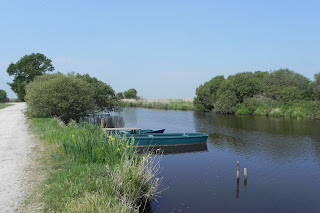
Canal de RozeWith traffic speeding past, our viewing point did not feel very safe, so we moved on toour next destination, Rozé. This turned out to be a very productive area. Serin were in the top of a pine tree in a garden next to our parking spot. We crossed the canal and began the walk to the hide. Scanning over a field with a few cattle, song and mistle thrush were found, and white stork could be seen circling high in the distance. Suddenly Steve called out that he had found a bluethroat. Woohoo! It was perched on a fence post about 50m away. A first for all of us.
 
Our exploration of this site produced over 50 species, notably zitting
A view of the marshes at Roze
cisticola, turtle dove, cetti’s, marsh harrier, white stork, yellow wagtail, black and whiskered tern, sacred ibis, cattle and great white egret, bar-headed goose, black-winged stilt, garden warbler, and cuckoo. As we neared the hide they were just locking up for the day! On the walk back a Camberwell beauty and swallowtail butterfly were nice additions, along with one other butterfly that David thought may have been a pearl-bordered fritillary.
 
All-in-all a very nice birding spot (Steve remembered that he had been here before – and the hide was closed on that occasion too!).
 
Time to move on – our next destination was La Chaussée Neuve. Black kite, marsh harrier, zitting cisticola, booted eagle and kestrel were spotted as we slowly made our way there.
 
A viewing mound at La Chaussée Neuve provided some height to look over the surrounding marshes. New additions to our list here included Mediterranean gull, black-tailed godwit, whitethroat, yellow wagtail and purple heron. Dark and threatening clouds began to approach so we returned to the car, arriving just as the rain began.
 
Loose-flowered orchid, Breca, Brierre, Brittany
The rain stopped soon after we arrived at the our next port-of-call, Breca. Yellowhammer, a distant black kite and a brief view of a flying garganey here. The rolling of thunder and a few spots of rain caused me to retreat back to the car, which meant I missed the booted eagle seen by David and Steve, but we all saw the overflying spoonbill. We also found a loose-flowered orchid and what I thought was a male broad-bodied chaser here.
 
Time was getting on and we decided we had better make tracks back towards our home base, but there was still time left to visit a couple of sites on the Golfe du Morbihan. The thunderstorm continued as we drove back to the gulf, but luckily it had cleared by the time we arrived. We parked up on a headland just north of St. Colombier. Whimbrel and curlew were seen together, allowing us to compare the size difference between these two species. Bar-tailed godwit and grey plover in breeding plumage were a fine sight, and a few Brent geese could be seen off-shore (tens of thousand of Brent over-winter in the gulf).
Chateau Suscinio from the beach
 
A short drive brought us to our last site for the day, the beach at Chateau Suscinio. Pools held several
species of wader (avocet, black-winged stilt, redshank, dunlin, bar-tailed godwit and little ringed plover). Skylark and zitting cisticola were performing their singing display flights and we watched a cuckoo feeding on caterpillars in a small bush.
 
Returning to our b&b quite late in the day, we showered quickly before walking the short distance to Les Logoden crêperie for another delicious evening meal (washed down with Bonnet Rouge local beer and a couple of jugs of the local cider).
 

Sun 1 May 2011

We awoke to a wet morning and at breakfast Richard informed us that the forecast was for a rainy day. We finished breakfast quickly so that we did not waste any time before setting off on the 80km drive to the Guérande saltpans. 
 
Bluethroat at Guerande saltpans, Brittany (photo by Steve Cload)
Turning off the D774 at Saillé, we stopped at the first available parking place on the narrow road through the saltpans. Luckily the rain had stopped when we arrived. We thought we could hear the song of a bluethroat from nearby bushes and it was not long before it obligingly showed itself. This is one of Steve’s digiscoped photos of it (© Steve Cload).
 
We continued to explore in the car, stopping at several locations to wander around. Another bluethroat was found at one such place, and also a zitting cisticola gave good views as it perched on a small shrub.
 
About 50 species were seen in this area, but only a couple of new ones to our list – turnstone and a heard only grasshopper warbler which we failed to find. It fact it went silent as we searched around for it.
 
We stopped at a pâtisserie in Le Croisic for a pain au chocolat to sustain us, before heading back to the Golfe du Morbihan for an afternoon visit to the Réserve Naturelle des Marais de Séné. This is an area of old saltpans that has been restored as a nature reserve.
 
Réserve Naturelle des Marais de Séné
As we arrived we had great views of a turtle dove purring away from a wire. As we wandered around the reserve visiting each of several hides in turn we accumulated another good list of species. Wheatear and greenshank were new ones for the trip, and another bluethroat (our eighth!).
 
As David and I were trying (unsuccessfully) to persuade a mole cricket out of its burrow in the path, Steve located a melodious warbler. It was singing well, but it was very coy about showing itself and we only had brief views of it. In the last hide we watched a couple of cuckoos feeding on the hairy caterpillars in the bushes, and the visit was crowned by two spotted redshank in full breeding plumage, which none of us had seen before.
 
After returning to our b&b we walked to Les Logoden crêperie again for our evening meal as we had enjoyed it so much the previous night. (Ok, we admit that it was the pretty French waitress that spoke so good English that was the main attraction!). This time we just kept to the cider and gave the beer a miss.
 

Mon 2 May 2011

An early breakfast today so that we could leave by 7.00am for the drive back to St. Malo. An uneventful journey and we arrived in plenty of time for the 10.30 sailing of the Bretagne back to Portsmouth.
 
Sea watching from the deck was disappointing as all we saw were a few gannets, cormorants and gulls. There was  a fairly strong north-easterly wind which hit us as we rounded the Cherbourg peninsula. We went back out on deck as the ship pitched into the waves with lots of spray breaking over the bow. David and Steve saw a petrel (probably a storm) which I was miffed not to have seen. With nothing much to see, we returned inside and installed ourselves in the restaurant and watched the waves breaking over the bow. Soon after it was announced that the outside decks were off-limits for the rest of the voyage due to the conditions.
 
We docked in Portsmouth about 18:30, slightly later than scheduled due to the sea conditions. An uneventful drive back to Oxfordshire and the long weekend was all over.
 
Steve and I would like to express our thanks to David for making all the arrangements and driving us safely around (we will gloss over the incident when DL attempted to drive off with Steve half in/half out of the car!).
 

The Bird List

 
Mute Swan Greylag Goose
Brent Goose Bar-headed Goose
Shelduck Mallard
Garganey Shoveler
Pochard Tufted Duck
Pheasant Great Crested Grebe
Petrel (Storm ?) Gannet
Cormorant Cattle Egret
Little Egret Great White Egret
Grey Heron Purple Heron
White Stork Sacred Ibis
Spoonbill Black Kite
Booted Eagle Marsh Harrier
Buzzard Kestrel
Hobby Moorhen
Coot Oystercatcher
Black-winged Stilt Avocet
Little Ringed Plover Grey Plover
Lapwing Knot
Dunlin Black-tailed Godwit
Bar-tailed Godwit Whimbrel
Curlew Spotted Redshank
Greenshank Redshank
Turnstone Black-headed Gull
Mediterranean Gull Lesser Black-backed Gull
Herring Gull Great Black-backed Gull
Whiskered Tern Black Tern
Common Tern Woodpigeon
Collared Dove Turtle Dove
Cuckoo Swift
Green Woodpecker Great Spotted Woodpecker
Skylark Swallow
House Martin Tree Pipit
Meadow Pipit Yellow Wagtail
Grey Wagtail White Wagtail
Wren Dunnock
Robin Nightingale
Bluethroat Redstart
Whinchat Stonechat
Wheatear Blackbird
Song Thrush Mistle Thrush
Cetti's Warbler Zitting Cisticola
Grasshopper Warbler (h) Sedge Warbler
Reed Warbler Melodious Warbler
Blackcap Garden Warbler
Whitethroat Wood Warbler
Chiffchaff Goldcrest (h)
Firecrest (h)? Long-tailed Tit
Blue Tit Great Tit
Crested Tit Willow Tit (h)?
Marsh Tit Nuthatch
Treecreeper Jay
Magpie Jackdaw
Rook Carrion Crow
Starling House Sparrow
Chaffinch Serin
Greenfinch Goldfinch
Linnet Yellowhammer
Reed Bunting  
Total 117 species

The Insect List

 
Swallowtail Camberwell Beauty
Pearl-bordered Fritillary ? Large Copper
Mole Cricket Broad-bodied Chaser
   

Others

 
Coypu Unidentified Lizard