(or Three go off to Europe again to escape another Royal event)
Thu 31 May 2012
An 11.30pm departure from Wallingford to drive down to Folkestone to catch the 03:27 Eurotunnel train to Calais.
Fri 1 Jun 2012
We tried to get some sleep during the journey “sous la Manche” but only managed an uncomfortable doze. Emerging into France just after 5.00am (having put our watches forward an hour) our first destination was the Réserve Naturelle du Platier d’Oye, a mere 18km from the Chunnel terminal. This was chosen because it was so close and would give us the chance, if needed, for a bit of a rest before the four-and-a-half hour drive to Zwanenwater in the Netherlands.
As we started our walk an unfamiliar bird song was heard from the bushes. We never saw the bird and it remained unidentified, but I suspect that it may have been our first Icterine warbler of the trip.
We spent a couple of hours exploring around this reserve and noted about 30 species including avocet, little egret, Cetti’s warbler and nightingale (last two heard only). There was one other bird singing from the top of a shrub that we did not recognise. Pondering this after the trip I wondered if this may have been a marsh warbler.
There was a lot more to explore at this area, but as we wanted to press on with our journey we would have to leave this to another time.
We broke the journey for coffee and a bite to eat on the A18 10km south-west of Oostende (where all the vehicles in the car park had British registration plates!). The satnav lead us via Gent, Antwerp, Utrecht and Amsterdam to Zwanenwater on the north-west coast of the Netherlands, arriving just after mid-day. Steve claimed black-tailed godwit and a possible hobby during the journey, but David and I missed them as we were asleep.
A short break for a sandwich and a drink and then we set out on a 4.5km walk around this reserve. An impressive display of wild flowers greeted us as we began. None of us are expert on flowers but we did recognise common spotted orchid, ragged robin, yellow rattle and flag iris. Roughly 45 bird species were seen/heard during our three-and-a-half hours here, including our first bluethroats of the trip, marsh harrier, tree pipit, kestrel (which had caught a small lizard), grasshopper warbler and garden warbler (last two heard only).
We left at 4pm as we still had a two-hour drive to the Hotel de Smittenberg in Beekbergen (near Appeldoorn) where we would be staying. On arriving and checking-in we took ten minutes to get all our gear in our rooms and then headed straight to the restaurant for dinner. Then a shower and an early night to try and catch up on some missed sleep before the another early start next morning.
Sat 2 Jun 2012
Steve and I were ready in plenty of time for our 5.00am departure, but where was David? I knocked on his door just after 4.50 to find him still asleep as his alarm had failed to go off. We still managed to set off in time though!
Nationaal Park Veluwezoom
We were due to meet Henk Ruissen at 5.30, a local birder that we had contacted via Birdingpal, who had kindly offered to show us around. With the rendezvous point programmed into the satnav we drove straight there without problem to find Henk waiting for us at the appointed place. After introducing ourselves we headed into the forest to get on with the birding.
The early morning light in the woods was rather dull, so seeing the birds was quite difficult, but there was plenty to be heard. Chiffchaff, chaffinch, wren, blackcap, song thrush, blackbird, cuckoo, robin were all singing, and all eventually seen. The yickering call of a sparrowhawk was heard in the distance, and the song of treecreeper was heard many times, but a sighting of the bird eluded us, much to our disappointment as this was the short-toed variety which would be a new tick for all of us. The distant drumming of a lesser spotted woodpecker and possibly that of a middle spotted was heard tantalisingly in the distance, but too far away for any chance of finding the source (these were two of our target species for the trip).
From the woodland we emerged into open heathland. An elevated viewpoint gave us an opportunity for a break as we scanned the landscape. An unidentified bird of prey flew below us and disappeared into clump of trees. A couple of tree pipits were singing from the top of nearby trees and a garden warbler was also about. As we moved off a bird of prey flew over – a honey buzzard (possibly the bird seen a few minutes before). A new tick for all of us.
We moved on and found a stonechat. As we approached a road and the edge of more woodland, Steve announced that he could hear a hawfinch (how does he remember all these seldom heard calls?). And he was right – a hawfinch flew from the top of one tree to another. Only a brief view, but a nice tick nonetheless.
We descended into the valley of this rather strange looking landscape (the result of glaciation). At the edge of the woodland we heard and found a redstart (we had heard these earlier but had not succeeded in seeing them).
A lone tree on the valley bottom had a bird softly calling from it. We searched around for fifteen minutes trying to find the bird, but without success. We gave up and began to move away, and as we did so saw a couple of hawfinch fly into the tree. Probably what we had heard was a fledgling hawfinch waiting to be fed and the two adults had been silently watching us until we had moved to a safe distance. Hawfinch seem to be easier to find here than in the UK. Before we had walked much further the sweet song of a woodlark was heard.
Once back in the woodland we caught glimpses of a few wild boar and found a spotted flycatcher. At last we managed to get views off a short-toed treecreeper. Dave, Steve and Henk glimpsed a goshawk gliding above the trees, but I missed it as I was a few metres ahead and had no view through the canopy of trees. Grrrrr!
After six-and-a-half hours we arrived back at the car. We followed Henk (on his bicycle) back to his home where we had coffee and sampled his daughter’s freshly baked blueberry muffins (delicious). Took lunch in his garden, feasting on some of the huge quantity of croissant, rolls and sandwiches provided for us by our hotel.
Westervoort
After lunch Henk took us a couple of kilometres from his home, to an area that is designed to hold flood water from the River Ijssel. In the two small lakes here we found waders such as redshank, black-tailed godwit, little ringed plover and oystercatcher (the latter on someone’s lawn). A few ducks, the ubiquitous greylag, and the only lesser whitethroat heard on the trip. Most notable bird here was a yellow wagtail of the European sub-species with the blue-grey head.
Loo
A short stop at this village to take a look at the small lake from the road. A greenshank and a wood sandpiper found here. As we drove on to the next destination we stopped to view a white stork sat in a nest with a chick.
De Jezuiten Waai
This is a lake south of Groessen between Zevenaar and the Pannerdensch Canal. Spoonbill, black tern and peregrine added to our list here. The black tern were nesting on small rafts in the lake, the peregrine on a platform near the top of an electricity pylon (we though we could see a chick in this nest, but it was at a considerable distance). A good selection of warblers about – chiffchaff, reed, sedge, whitethroat and willow. Also an Icterine warbler was singing well, but despite searching long and hard we did not succeed in seeing it as it delivered its song well hidden high up in the tall hedgerow. The song is loud and fast with repeated phrases, reminiscent of a song thrush. It also includes a nasal, and very distinctive, “gie gie gie”. Also seen of note were hobby and marsh harrier.
At about 5pm we called it a day so that we could take Henk home and get back to our hotel for dinner and a shower. In fact we gave dinner a miss and took some drinks from the bar up to David’s room and finished off the rest of the sandwiches and fruit that the hotel had provided for us.
Nightjars
A late rendezvous with Henk in the Veluwe to go looking for nightjars. During the two kilometre walk to our chosen spot we found tree pipit, stonechat and a couple of cuckoos. The first nightjar began churring just after 10.00pm and while we waited for them to show a large unidentified bat was seen swooping over a small pond (Daubenton’s?). After a twenty-five minute wait the nightjars at last began to fly and we saw a couple before calling it a day and beginning the long walk back to the car. Tawny owl were heard in the wood near the car park – probably a young family being fed.
Not such an early start this morning, so a chance to take a fairly leisurely breakfast in the hotel before the one hour drive to the Oostvaardersplassen nature reserve in Flevoland. The weather was not so good today and when we arrived it was raining. Calling into the visitor centre to get a reserve map and ask where to find the white-tailed eagles, we were surprised to learn that there was no entry fee. As we left a Dutch lady, hearing us speak English, asked if we had come all the way from England. We had a chat with her, discussing the weather (as English people are wont to do) etc. Her parting words were to remind us that it was Springwatch on the BBC at 8.00pm. Apparently it is a popular programme in the Netherlands.
As it was still raining we walked the short distance to the first hide and hoped that it would clear up while we sat in there. Best birds seen from here were a splendid male hen harrier, both male and female marsh harriers, and later a female hen harrier. Many house martins feeding over the lake, but only the odd sand martin.
We decided that we would have to move on and brave the weather, so we made our way to the next hide. The song of a short-toed treecreeper was heard from a stand of willows, but we failed to find it. Sheltering from the rain in the leaky second hide, we had great views of a bluethroat singing from the top of the reeds. An Icterine warbler sang from the trees behind the hide, but true to form it remained well hidden. We thought we heard a marsh warbler as well, but this remained unconfirmed.
The rain began to ease and we moved on. Another elusive “icky” and a more obliging garden warbler. Then we stumbled upon a bluethroat singing out in the open at the top of a reed. As Steve was photographing this bird it took flight, circled around above us, and then parachuted down, calling as it descended with its feathers spread displaying its colourful plumage. It alighted less than five metres distant at the top of another reed and continued singing oblivious to our presence. A memorable experience.
With the weather now much improved we crossed a waterway and moved into what was once a woodland area. But now most of the trees were either standing dead or had fallen. We discovered later that this was due to the local red deer and ponies stripping off the bark. Spotted flycatchers seemed to like this habitat though as there were many present. A bird of prey perching in the top of one of the dead trees caused us puzzlement. Much debate followed, but we eventually decided that it was just a buzzard.
We reached the two-storey Observatory where a couple of Dutch birders pointed out a pair of sea-eagles (more properly white-tailed eagles) to us, resting on the ground in the distance. We had been there only moments when these huge birds took flight, circled around mobbed by a few waders and corvids, and then flew off into the distance with a solitary plucky lapwing finally seeing them off. We reflected on how lucky we were to see these, as if we had arrived just five minutes later we would have missed them. After the eagles everything else could have been an anti-climax, but there were other good birds to be seen e.g. white stork, avocet, Med gull, ringed plover, great white egret, grey plover and male hen harrier.
Continuing through the “dead” forest, Steve and David were puzzling over “that” buzzard again whilst I went slightly ahead. I had to beckon them to me as I found myself surrounded by a young family of willow tits being fed by their parents. A lifer for me, but I was pleased to note that I easily identified them as willow and not marsh tit. The shape was completely different with a decidedly bull-necked appearance.
The hedge-lined corridor leading to the fourth hide held another family – this time redstarts. We had good close views of both the fledglings and the adults as they brought food for their youngsters.
The long walk back to the car park added raven and more invisible Icterine warblers. The day was not done though, as almost back at the visitor centre we found a marsh warbler singing in full view from the top the reeds.
It was beginning to rain again, so we adjourned to the visitor centre for a cup of tea (coffee for David of course). Our stomachs began to remind us that we had had nothing to eat all day, so we retrieved the cool-box full of sandwiches provided by our hotel and sat in the first hide eating them (with a swallow circling around inside the hide).
This was a great day’s birding (70+ species, including two lifers for me). We had intended to visit other sites in the area, but this reserve was so good that we spent the whole day there.
Mon 4 Jun 2012
Henk was able to be with us again today and had suggested we visit Tiengemeten. This is an island of about 1,050 hectares south west of Rotterdam in the delta where the Rhine, Meuse and Scheldt rivers flow into the sea. As recently as 2007 it was agricultural land, but it has now been given back to nature by breaching the dike and allowing a large part of the island to flood.
It is only accessible by ferry which sails on the hour. The satnav predicted our arrival at 9.30 so we thought we would arrive in plenty of time, but it had not allowed for the horrendous traffic jam on the A15 approaching Rotterdam. The ETA slipped back to beyond 10.00, but as were neared Henk phoned ahead to the ferry captain, who agreed to wait for us. What service!
We pulled up into the car park just after ten and had to hurriedly get our gear from the car and put on our boots and waterproofs (it was pouring!) while the ferry waited. The crossing took only ten minutes, and once on the island we headed for the shelter of the visitor centre were we had coffee and ate some of the generous supply of sandwiches/rolls provided again by our hotel.
Sadly, the weather showed no sign of improving and we had to set off in the cold wind and the rain. The conditions made observing birds through bins and scopes very difficult, and the list of species seen was made back at the hotel in the evening from memory. Additions to our trip list were garganey, pochard, red-crested pochard, and snipe.
We caught the 1.00pm sailing back to the mainland. The entrance fee was collected on board – €3.50 each less €0.50 for Natuurmonumenten members. We were generously allowed the discount for being RSPB members (or was it because they took pity on our wet and bedraggled state!). It was a shame that the weather was so awful, as this was certainly a great birding spot, but it would have been the same wherever we had gone today.
On the way back we stopped in a restaurant for some delicious Hollandsche appel koek (Dutch apple cake) as a small token of thanks to Henk for giving up his time to show us around.
Tues 5 Jun 2012
Departure day. Our plan had been to head for The Zwin, a reserve just over the border in Belgium, but Henk had suggested a couple of other sites that we could visit en-route. Therefore our first destination was Hoofdplaat on the south coast of the Westerschelde estuary, a journey of 250km which included travelling through the 6.6km tunnel under the Westerschelde. The main attraction here was the tern colony which held both common and the rarer little tern (another new species for us). Also found were avocet, a small flock of bar-tailed godwit, grey plover and a solitary bar-headed goose.
After munching some of the hotel’s sandwiches we moved on a few kilometres to the Ringdijk (north of Oostburg). A few small lakes here which held many black-necked grebe with young, Egyptian goose, barnacle geese and a marsh harrier in the distance.
And on into Belgium and our final site, the Zwin. A quote from David’s email to Henk:
“Unfortunately we arrived too late at the Zwin to allow us to stay more than 30 minutes, but in that time we were lucky enough to find a very bold Icterine warbler, singing and showing very well in a small bush by the roadside! It obviously hadn't read the Icterine warbler Rule Number 1, i.e. that it should always skulk, just out of sight, on the far side of a leafy tree! It was good to make a positive sighting of this tricky bird.
“Also at the Zwin were white storks - lots of them! Another time we will have to make sure we have plenty of time to explore this very large reserve, as I'm sure there would have been lots to enjoy.”
And so the birding came to an end and we made our way to the Eurotunnel terminal for our return journey to England.
The Bird List
Mute Swan
Greylag Goose
Canada Goose
Barnacle Goose
Egyptian Goose
Bar-headed Goose
Shelduck
Gadwall
Mallard
Garganey
Shoveler
Red-crested Pochard
Pochard
Tufted Duck
Red-legged Partridge
Pheasant
Great Crested Grebe
Black-necked Grebe
Cormorant
Little Egret
Great White Egret
Grey Heron
White Stork
Spoonbill
Honey-buzzard
White-tailed Eagle
Marsh Harrier
Hen Harrier
Goshawk
Sparrowhawk
Buzzard
Kestrel
Hobby
Peregrine
Moorhen
Coot
Oystercatcher
Black-winged Stilt
Avocet
Little Ringed Plover
Ringed Plover
Grey Plover
Lapwing
Dunlin
Snipe
Black-tailed Godwit
Bar-tailed Godwit
Curlew
Greenshank
Wood Sandpiper
Redshank
Black-headed Gull
Mediterranean Gull
Common Gull
Lesser Black-backed Gull
Herring Gull
Great Black-backed Gull
Little Tern
Black Tern
Common Tern
Feral Pigeon
Stock Dove
Woodpigeon
Collared Dove
Cuckoo
Tawny Owl (h)
Nightjar
Swift
Green Woodpecker
Great Spotted Woodpecker
Middle Spotted Woodpecker (h)?
Lesser Spotted Woodpecker (h)?
Woodlark (h)
Skylark
Sand Martin
Swallow
House Martin
Tree Pipit
Meadow Pipit
Yellow Wagtail (ssp flava)
White Wagtail
Wren
Dunnock
Robin
Nightingale (h)
Bluethroat
Redstart
Stonechat
Blackbird
Song Thrush
Cetti’s Warbler (h)
Grasshopper Warbler (h)
Sedge Warbler
Marsh Warbler
Reed Warbler
Icterine Warbler
Blackcap
Garden Warbler
Lesser Whitethroat (h)
Whitethroat
Wood Warbler (h)
Chiffchaff
Willow Warbler
Goldcrest
Spotted Flycatcher
Long-tailed Tit
Blue Tit
Great Tit
Crested Tit
Willow Tit
Nuthatch
Short-toed Treecreeper
Jay
Magpie
Jackdaw
Rook
Carrion Crow
Raven
Starling
House Sparrow
Chaffinch
Greenfinch
Goldfinch
Linnet
Hawfinch
Yellowhammer
Reed Bunting
Total 127
In Conclusion
Once again Steve and I are indebted to David for taking on the task of making all the arrangements for this trip. We appreciate all the work done on research, sorting out our accommodation and the Eurotunnel, and finding a great local guide (Henk), and not least, for the use of the car. Many, many thanks David for all that you did to make this such a successful trip.
And, of course, a very big thank you to Henk for generously giving his time to show us around. Without your help we would not have seen half as much as we did, so thanks very much Henk, we are all extremely grateful.
(or Three go off to France to escape the royal wedding)
Thu 28th April 2011
David, Steve and I decided to take the opportunity of the royal wedding/May day bank holidays to get in a few days bird watching in Brittany (and of course avoid the wall-to-wall coverage on every TV, radio and newspaper of the event). So Thursday evening found us waiting at Portsmouth for the 20.15 sailing of the Bretagne to St. Malo. Once on board we headed for the restaurant for a cup of tea and a snack, then went out on deck to watch as we sailed out of port. A relaxing pint in the lounge bar before heading to our cabin to turn-in.
Fri 29th April 2011
The ferry docked at 08:15 local time and we were soon on our way south. Our first destination was the Forêt de Rennes where we hoped to find various species of woodpecker. Nothing much seen en-route other than woodpigeon, starling and house martin. It took little more than an hour to get to our chosen spot in the forest – a point on the D528 where several tracks converge.
The air was full with bird-song as we prepared to set off into the woods, and we had blackcap, chiffchaff, crested tit, and wood warbler before we had even moved from the car. A redstart was heard, but only Steve managed to get a sighting of it.
As we wandered through the woods birds were heard, but as is usually the case in woodland, they were difficult to see. I thought I heard and glimpsed a willow tit, but I was not confident enough to claim it as a definite. A tree pipit was seen well as it delivered its song from a dead branch high up in a pine tree. Cuckoo were heard in the distance but the only woodpeckers heard were green and great spotted. A treecreeper was seen as we neared the car. Although the song sounded like Eurasian, the distribution maps show that it is short-toed that are present in Brittany. As both species are known to be able to do the other’s songs we were unable to say for sure which flavour this was.
Moving on, we travelled west on the N24 to the Forêt de Paimpont, where, after an exploratory drive on the minor roads in the forest, we stopped by the Étang du Pas du Houx. A white wagtail was on the road in front of us. As we scanned the water a bird of prey was spotted over the trees on the far side of the lake. It immediately stooped and disappeared behind the trees. Within seconds it re-appeared along with a second bird, being mobbed by crows. Our first booted eagles for the trip.
Still beside the car, we heard what sounded like a firecrest in the top of a pine tree. We only managed to get brief glimpses of the bird in the dense foliage so could not confirm this. In an adjacent tree a family of tits were calling. We think these were either marsh or willow tits, but again they did not show well enough to be certain. Oh to be a more skilled birder!
We walked eastwards along a track (part of the GR37) past the southern edge of the lake and into the forest. Species added to our list included grey wagtail, nuthatch and jay. Crested tit were again seen well, and pochard were present on the lake when we returned to the car.
We stopped for sandwiches at Brocéliande services on the N24 as we continued south to our next destination, Marais de Pen en Toul near Larmor-Baden on the Golfe du Morbihan. This is an area of old saltpans that is now managed as a nature reserve. Access is not permitted during the breeding season, but it can be viewed from the entrance and the road.
A good selection of birds seen here, including common tern, little egret, grey heron, cormorant, lesser and greater black-backed gulls, whinchat and stonechat. The common terns approached very close as we viewed from a wooden footway. A walk in nearby woodland produced nuthatch, long-tailed tit and more crested tit.
After a long day travelling and birding we headed for our B&B in Arradon, where we were greeted by Catherine Sadek, one of the owners. Just time to dump all our gear in our rooms and have a quick shower before walking the short distance to the restaurant that David had booked for our evening meal (L’Auberge d’Arradon). And a very nice meal it was too.
Sat 30 Apr 2011
Breakfast at 8.00am, served by Richard Sadek, our host. A traditional French affair of croissant, bread, jams, yoghurt and tea/coffee. No time to hang about as we wanted to get away as soon as possible to the La Grande Brière, a journey of 75km.
Our first port of call was Île de Fédrun. This turned out to be a bad choice as there was nowhere that we could walk, only trips on punts, which none of us were keen on. So we drove back a short distance through St. Joachim to get a better view of some sacred ibis we had passed earlier. Black-winged stilt, lapwing, marsh harrier, little egret, and grey wagtail were also seen here as we scanned over the marsh from the side of the road.
With traffic speeding past, our viewing point did not feel very safe, so we moved on toour next destination, Rozé. This turned out to be a very productive area. Serin were in the top of a pine tree in a garden next to our parking spot. We crossed the canal and began the walk to the hide. Scanning over a field with a few cattle, song and mistle thrush were found, and white stork could be seen circling high in the distance. Suddenly Steve called out that he had found a bluethroat. Woohoo! It was perched on a fence post about 50m away. A first for all of us.
Our exploration of this site produced over 50 species, notably zitting
cisticola, turtle dove, cetti’s, marsh harrier, white stork, yellow wagtail, black and whiskered tern, sacred ibis, cattle and great white egret, bar-headed goose, black-winged stilt, garden warbler, and cuckoo. As we neared the hide they were just locking up for the day! On the walk back a Camberwell beauty and swallowtail butterfly were nice additions, along with one other butterfly that David thought may have been a pearl-bordered fritillary.
All-in-all a very nice birding spot (Steve remembered that he had been here before – and the hide was closed on that occasion too!).
Time to move on – our next destination was La Chaussée Neuve. Black kite, marsh harrier, zitting cisticola, booted eagle and kestrel were spotted as we slowly made our way there.
A viewing mound at La Chaussée Neuve provided some height to look over the surrounding marshes. New additions to our list here included Mediterranean gull, black-tailed godwit, whitethroat, yellow wagtail and purple heron. Dark and threatening clouds began to approach so we returned to the car, arriving just as the rain began.
The rain stopped soon after we arrived at the our next port-of-call, Breca. Yellowhammer, a distant black kite and a brief view of a flying garganey here. The rolling of thunder and a few spots of rain caused me to retreat back to the car, which meant I missed the booted eagle seen by David and Steve, but we all saw the overflying spoonbill. We also found a loose-flowered orchid and what I thought was a male broad-bodied chaser here.
Time was getting on and we decided we had better make tracks back towards our home base, but there was still time left to visit a couple of sites on the Golfe du Morbihan. The thunderstorm continued as we drove back to the gulf, but luckily it had cleared by the time we arrived. We parked up on a headland just north of St. Colombier. Whimbrel and curlew were seen together, allowing us to compare the size difference between these two species. Bar-tailed godwit and grey plover in breeding plumage were a fine sight, and a few Brent geese could be seen off-shore (tens of thousand of Brent over-winter in the gulf).
A short drive brought us to our last site for the day, the beach at Chateau Suscinio. Pools held several species of wader (avocet, black-winged stilt, redshank, dunlin, bar-tailed godwit and little ringed plover). Skylark and zitting cisticola were performing their singing display flights and we watched a cuckoo feeding on caterpillars in a small bush.
Returning to our b&b quite late in the day, we showered quickly before walking the short distance to Les Logoden crêperie for another delicious evening meal (washed down with Bonnet Rouge local beer and a couple of jugs of the local cider).
Sun 1 May 2011
We awoke to a wet morning and at breakfast Richard informed us that the forecast was for a rainy day. We finished breakfast quickly so that we did not waste any time before setting off on the 80km drive to the Guérande saltpans.
We continued to explore in the car, stopping at several locations to wander around. Another bluethroat was found at one such place, and also a zitting cisticola gave good views as it perched on a small shrub.
About 50 species were seen in this area, but only a couple of new ones to our list – turnstone and a heard only grasshopper warbler which we failed to find. It fact it went silent as we searched around for it.
We stopped at a pâtisserie in Le Croisic for a pain au chocolat to sustain us, before heading back to the Golfe du Morbihan for an afternoon visit to the Réserve Naturelle des Marais de Séné. This is an area of old saltpans that has been restored as a nature reserve.
As we arrived we had great views of a turtle dove purring away from a wire. As we wandered around the reserve visiting each of several hides in turn we accumulated another good list of species. Wheatear and greenshank were new ones for the trip, and another bluethroat (our eighth!).
As David and I were trying (unsuccessfully) to persuade a mole cricket out of its burrow in the path, Steve located a melodious warbler. It was singing well, but it was very coy about showing itself and we only had brief views of it. In the last hide we watched a couple of cuckoos feeding on the hairy caterpillars in the bushes, and the visit was crowned by two spotted redshank in full breeding plumage, which none of us had seen before.
After returning to our b&b we walked to Les Logoden crêperie again for our evening meal as we had enjoyed it so much the previous night. (Ok, we admit that it was the pretty French waitress that spoke so good English that was the main attraction!). This time we just kept to the cider and gave the beer a miss.
Mon 2 May 2011
An early breakfast today so that we could leave by 7.00am for the drive back to St. Malo. An uneventful journey and we arrived in plenty of time for the 10.30 sailing of the Bretagne back to Portsmouth.
Sea watching from the deck was disappointing as all we saw were a few gannets, cormorants and gulls. There was a fairly strong north-easterly wind which hit us as we rounded the Cherbourg peninsula. We went back out on deck as the ship pitched into the waves with lots of spray breaking over the bow. David and Steve saw a petrel (probably a storm) which I was miffed not to have seen. With nothing much to see, we returned inside and installed ourselves in the restaurant and watched the waves breaking over the bow. Soon after it was announced that the outside decks were off-limits for the rest of the voyage due to the conditions.
We docked in Portsmouth about 18:30, slightly later than scheduled due to the sea conditions. An uneventful drive back to Oxfordshire and the long weekend was all over.
Steve and I would like to express our thanks to David for making all the arrangements and driving us safely around (we will gloss over the incident when DL attempted to drive off with Steve half in/half out of the car!).
After last year’s successful trip to the Brenne, David, Alan, Chris and I eagerly set off for a repeat trip to the same area. The first leg of the journey was an evening drive down to Portsmouth to catch the 22:45 ferry to Ouistreham. This was a change of plan as originally we had booked the following morning’s sailing to Cherbourg, but this had been cancelled at short notice. Sadly, this meant no sea-watching to kick start our list. After a cuppa in the restaurant we adjourned to our cabins in the hope of getting some sleep before the early morning start.
Mon 10 May 2010
We rose early for breakfast at 5.00am, then down to the car deck ready to disembark. Once off the ferry we soon had our first bird – a herring gull! The early start gave us the opportunity to visit a couple of sites in Normandy before the drive south to the Brenne, so our first destination was the museum at Utah Beach.
The monotonous “dzip… dzip… dzip…” song of a fan-tailed warbler could be heard coming from the bushes next to the car park. The bird was difficult to locate, but eventually it gave a brief display. The beach was devoid of birds, probably because of the sand-storm being whipped up by the wind. We moved a couple of kilometres along the coast to the Beaugillot Nature Reserve. An hour or so’s birding here found, amongst others, great white egret, black swan, marsh harrier, and a small flock of spoonbill. A coypu was in front of one of the hides.
Next, a short drive to the nearby Ponts D’Ouve reserve. Sadly no sign of any bluethroats, but we did manage to get a brief glimpse of a Cetti’s warbler as it flew across the river. A white stork was in its nest with young, a grasshopper warbler was heard, and another spoonbill was seen from the hide. Raptors included hobby, marsh harrier and kestrel.
The journey south was quite long, but fairly straightforward as it was mostly on motorways (A28/E502, A10/E05), which were very quiet compared to British motorways. A short rest stop at Alençon services for fuel and coffee and then we continued on our way. The only bird of note seen on the journey was a harrier, but from the car we could not be certain whether it was a Monty’s or hen.
As we neared Champ d’Oeuf David remarked that a clearing on the D14 through the Forêt de Preuilly looked an ideal place for nightjars (more on this later).
Not far from our destination there were piles of hail stones by the side of the road, and as we passed through wooded areas the road was covered with leaves. A thunder storm had recently passed, but luckily we had not driven through it. The storm could be seen to the south when we arrived at our gîte. The sky was very black, punctuated by flashes of lightning and the accompanying rolls of thunder.
As last year, we were staying at La Confiance, owned and run by Sue and Chris Mooney. Sue was there to greet us as we arrived, and as we unloaded the car a nightingale burst into song to greet us as well.
There was plenty of time to sort out our things and have a shower before walking around to Sue and Chris’s dining room for our four-course dinner.
Tues 11 May 2010
A short walk around the lanes of Champ d’Oeuf before breakfast found turtle dove, melodious warbler and a singing nightingale. After we had all breakfasted the first destination was the Chérine Nature Reserve near St. Michel-en-Brenne for a meeting with Tony Williams. He has lived and worked in the area for many years and is the best source for all the latest info. Although it is only a short drive, it took longer than expected as every “bird on wire” had to be investigated, and a marsh harrier held us up for several minutes. We had a good sighting of a water rail from the viewing window in the visitor centre whilst waiting for TW, and Alan spotted a reed warbler. Also black tern, little egret and marsh harrier.
TW’s info included the news that there were black woodpeckers nesting in a pine tree next to the restaurant at Étang de Bellebouche, so that was added to today’s itinerary. Also that the bee-eaters were no longer at Néons-sur-Creuse but had re-located to nearby Tournon-St-Martin.
The rest of the morning was spent thoroughly exploring the area around Chérine. First the Tower Hide at the north-east corner of Étang Ricot. Nightingale and blackcap were singing well in the wooded area surrounding the car park and a golden oriole was heard from the hide. Common tern, marsh harrier and black kite were also seen from the hide.
A few hundred metres further along the D17 there is a small parking area overlooking Étang de Monmélier. There was not much on the water, but a black-winged stilt flew over. (Note for next time: There is a track starting here that leads past Étang Miclos – this is worth checking out).
A track from the small parking area on the D44 leading past the north-western end of Étang Ricot through the Chérine Nature Reserve produced great birds last year, so we eagerly set-off along this path. A good number of species were seen including stonechat, cattle egret, great white egret, black kite, cuckoo, nightingale, gadwall, whiskered tern, red-crested pochard, melodious warbler, sand martin and cirl bunting. The reeling of a grasshopper warbler was heard as well.
On the drive to Bellebouche we got our first red-backed shrike and another cirl bunting. At Bellebouche we located the pine tree that TW told us was the site of a black woodpecker nest, but there was no sign of any woodpeckers. Brief glimpses of both hoopoe and golden oriole were some compensation, and also a tree-creeper – but was it the short-toed variety? A Bonelli’s warbler was giving it’s distinctive song, but it was very difficult to find in the dense foliage. A solitary little ringed plover was on the lake shore. We sat by the car to eat our lunch, listening to the distant song of a golden oriole. One final check of the pine trees before leaving, still no woodpeckers but we did see a red squirrel.
A purple heron was seen on a quick visit to the southern end of Bellebouche and a very pale, hovering bird of prey that I at first mistakenly thought was an osprey. It was in fact our first short-toed eagle.
Our final destination for today was Château Robert in the Forêt de Lancosme. As we were driving along the rough forest track we were all surprised when a black stork flew over – a first for all of us. Monkey orchid were growing close to where we parked the car. The walk in the forest produced a good view of a Bonelli’s warbler and one of the few robins seen on the trip. A black woodpecker was heard to call once, but no sightings. My pathetic attempts at imitating its call caused much amusement to my companions.
We had worked up quite an appetite from our day’s birding, so the delicious four-course dinner which Sue and Chris had prepared for us back at La Confiance was well received. A calling tawny owl was the only addition to our list on a short evening walk around the lanes of Champ d’Oeuf.
Wed 12 May 2010
Our pre-breakfast recce found a pair of stone curlews in a field not 200m distant from our gîte. Today was to be bee-eater day, and despite TW’s advice, we decided that we would check out the site at Néons-sur-Creuse first.
En-route we stopped for a few minutes at Étang Bourreau, a small lake alongside the D50. Lots of swallow, house martin and whiskered tern about, and a male harrier at first thought to be a Montagu’s, was quartering the fields in the distance. Closer inspection identified it as a hen harrier. A red-backed shrike appeared on a wire as we were leaving.
We parked by the small riverside play area in Néons-sur-Creuse. There was no sign of any bee-eaters so we took a stroll along the lane where we found corn bunting, melodious warbler, cirl bunting and stonechat plus several other common species. A red-backed shrike perched in the hedgerow to have its photograph taken, and a golden oriole was calling from the trees across the river, but we only managed to get a distant view of the flying bird. The most controversial bird of our trip was seen here. A very white bird of prey that could have been either a pale morph booted eagle or buzzard. I thought there were features that pointed to either species, but David was fairly convinced it was a buzzard. Anyway, it was all fairly academic as both species were definitely seen during this trip.
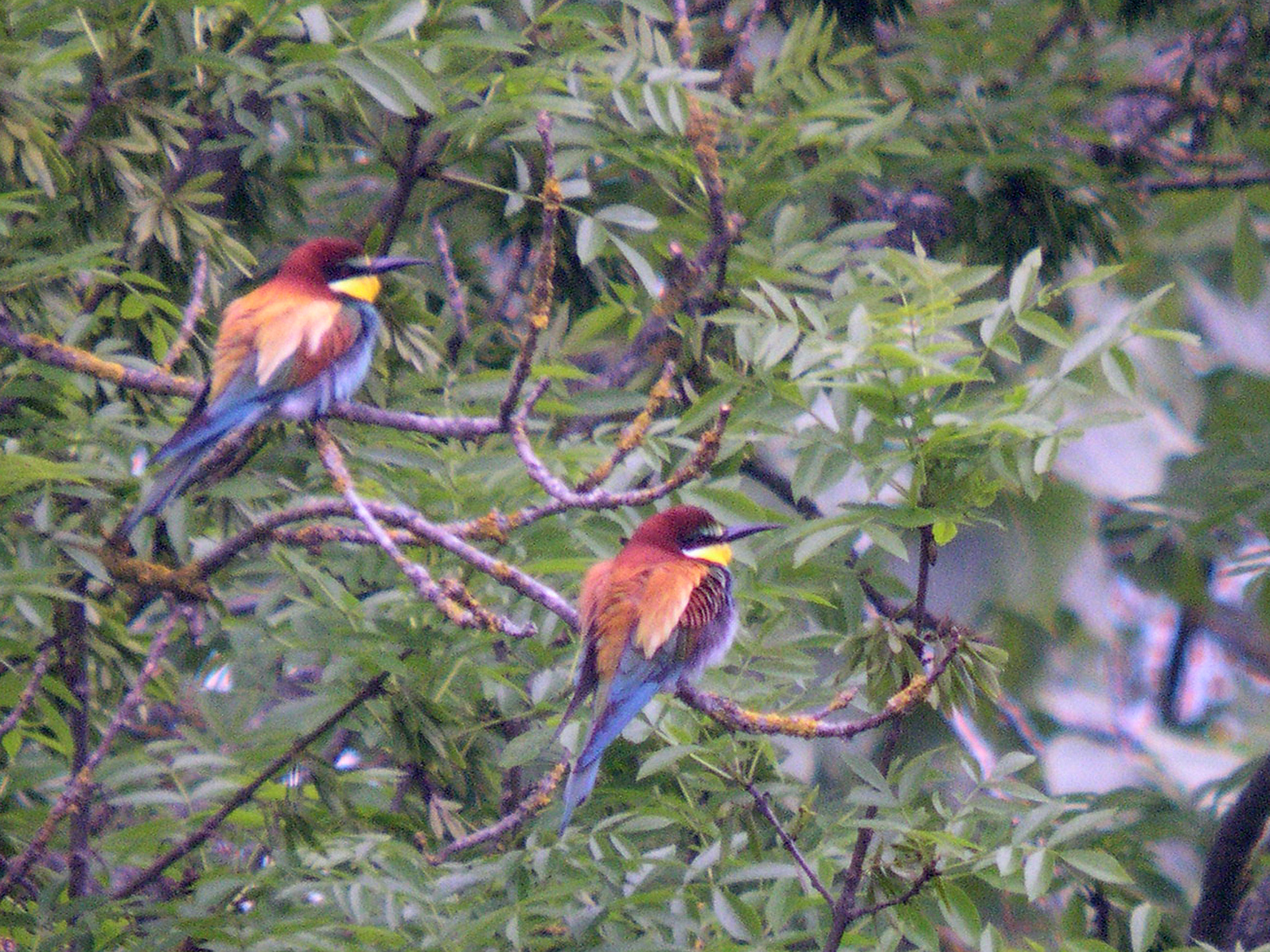
We were just packing our ‘scopes into the car prior to moving on when we all heard the unmistakable calls of bee-eaters. We rushed to the riverside where the sound was coming from and soon located the birds. A flock of five or six of them perched in a dead tree on the wooded island in La Creuse. A magnificent sight!
We watched them for a good twenty minutes before deciding it was time to move on. As we had now bagged the bee-eaters there was no need to go to Tournon-St-Martin so we headed for Étang de la Mer Rouge. Here we found another red-backed shrike and had good views of a booted eagle. More whiskered tern and a nightingale was heard (not unusual, as we heard these almost everywhere we went). A hornet was also encountered here.
En route to La Gabrière a possible peregrine flew over, and on the étang itself our first black-necked grebes. Black kite and booted eagle flew over as we viewed the lake from the roadside benches.
Making our way to Étang de la Sous we stopped to get a better view of a short-toed eagle which flew over. Butterfly orchids were growing on the verge here. A very impressive new hide had been constructed at Étang de la Sous and from it we saw great white egret, whiskered tern and purple heron. European pond tortoise (very common in the area) was also noted. A great reed warbler began singing from the extensive reed beds in front of the hide and we eventually located it and had a fairly good view for several minutes before it disappeared deep into the reeds. On returning to the car we found a tick on the dashboard. Chris made sure to keep her trousers firmly tucked into her socks after that.
A visit to the hide on Étang Massé at Le Blizon was not very productive. (Note for next time: there is a track here that runs by Étang du Blizon which would be well worth exploring).
Another brief visit to the Étang de Monmélier specifically to find black-winged stilts, which was successful. Yet another short-toed eagle flew over.
The final destination for today was an exploration of the lanes to the south-east of Azay-le-Ferron, where little bustards used to be found. Local knowledge is that they are no longer here, but we thought it was worth a look. On the D18 1km south-west of St-Julien a couple of Montagu’s harriers were seen being mobbed by curlew, but sadly no sign of any little bustards.
Whilst having our evening meal with Sue and Chris we were delighted to see a nightingale on the lawn of La Confiance.
Thu 13 May 2010
The customary pre-breakfast walk found nothing new, but it was a surprise to see a stone curlew take-off from a pasture with grazing cattle. Today’s itinerary was to explore the forests (mainly for woodpeckers) in the morning, and in the afternoon to have a guided orchid walk. A new species for our list was added on the way to the forest - greylag goose at Étang de la Bienaise. Several cattle egret were spotted in a field on the D21 near Bellebouche.
We drove deep into the Forêt de Lancosme, parked where five forest roads meet and walked along a forest track. Spotting birds was difficult because of the dense foliage, but Bonelli’s warbler and crested tit were seen well. Wood warbler, garden warbler and a treecreeper (the standard Eurasian type) were heard, and a brief glimpse of a golden oriole as it flew across the ride. We spent several minutes trying to locate a bird with an unusual song. We eventually found the culprit – a blackcap. It was an very un-blackcap like song though, it sounded more like a redstart.
We moved on to the nearby chapel of St.Sulpice for another wander through the woods. Nothing new found, but a treecreeper was heard (this one sounded like the short-toed variety). We were pleased to find a chequered skipper butterfly, a species that can only be found around Fort William in Britain. Sadly, the only woodpecker noted today was the call of a great spotted.
After returning to Champ d’Oeuf for a spot of lunch we headed off to Preuilly-sur-Claise to meet Susan Walter, an Australian naturalist living in France, and her partner Simon Brand, who were going to give us a guided orchid walk. We rendezvoused in the centre of the village, and after a brief introductory chat in the Hôtel de L’Image we made the short journey to their orchard. Alan and Chris travelled in style in the beautifully restored 1953 Citroën Traction Avant owned by Susan and Simon.
In the orchard we saw lady and early spider orchids and a rather splendid Glanville fritillary butterfly (only found on the Isle of White in Britain). We moved on to the nearby village of Boussay for a walk through the woods. Several more species of orchid were found here, including narrow-leafed helliborine, along with gendarme bugs, which was something none of us had seen before. A short-toed treecreeper was heard in the woods, but we did not manage to get any sighting of it.
After thanking Susan and Simon we went to check out the clearing we had seen on the day of our arrival, as we had decided that tonight we would have a late night excursion to find nightjars. A pair of stone curlew were found on a bare field nearby.
Having located a suitable spot to park the car we returned to Champ d’Oeuf for an early dinner. We left at about 9.00pm when there was still plenty of daylight, and en-route we saw a male hen harrier and stopped to have another look at the pair of stone curlews we had found earlier.
Our chosen spot was on the D14 in the Forêt de Preuilly, and after parking the car just off the road we walked a short distance into the woods. We were now surrounded by about 2m high scrubby vegetation with taller trees interspersed. It was a cool, but calm evening and several cuckoos were calling from the surrounding forest. As the light faded a bird was seen on the ground about 50m away. We struggled to identify it in the fading light, but our best guess was a mistle thrush. We all had doubts about this as the bird seemed much too grey. Afterwards we decided this could have been a fieldfare, as the area is not too far from their summer range.
As we stood in silence several large animals were heard routing around in the undergrowth just a few metres away from us. We did not see them, and had no idea what they were. We think they could have been either badgers or wild boar.
We were all beginning to have doubts that the habitat was right for nightjars, but at about 10.30 we at last heard the first brief churring call. The churring continued on and off for the next half hour or so, gradually increasing in intensity, from at least two birds. Suddenly the churring stopped and the frog like “kru-it” call began. The bird was obviously now moving and David and Alan began to wave white handkerchiefs. Instantly a nightjar made a close approach to us and then proceeded to fly around our heads. Although the light was now very feint, there was sufficient to enable us to see the bird in silhouette. In fact, it was the best views any of us had had of the species. Satisfied with our night’s work we made our way back to the car, only to have another nightjar flying around our heads as we got back to it.
Fri 14 May 2010
We rose early today so that we could make an early start to our return trip. It was the coldest morning of our visit, so cold that the car was covered in ice. We departed at 7.15 and headed west to Châtellerault, the quickest route to join the motorway network.
We lost count of the number of buzzards we saw sitting alongside the motorway as we journeyed north. A short break at La Dentelle d’Alençon services for coffee and to re-fuel broke up the journey. The plan was to get in a couple of hours birding at Sallenelles nature reserve on the Orne estuary before we went to the ferry and we arrived in plenty of time to do this. Shelduck, grey plover, oystercatcher, whimbrel and whinchat were added to our list here. There was one other bird that was heard only. It sounded at times like a song thrush, but this was only part of the song. Although we searched long and hard we never actually saw the bird, which we strongly suspect was a bluethroat.
Crossing the river and the canal via Pegasus Bridge we arrived at the ferry port in Ouistreham in plenty of time for our 4.30pm sailing to Portsmouth. Soon after the Mont St Michel docked an employee of Brittany Ferries walked round the waiting cars handing out a letter. This announced that there was a strike and they could not say when we would be allowed on board, it could be two hours, four hours or even twelve hours!
After a long and boring wait we eventually boarded and sailed about four hours late. There was not much time for sea-watching before the light faded, the only addition to our list during the crossing was gannet. It was well after midnight when we arrived in Portsmouth, and after dropping Alan and Chris at their home, picking my car up at David’s, it was not until gone 3.00am that I finally arrived home.
The weather had been unseasonably cold for the time of year, with a chilly north-easterly wind blowing. Warmer weather would probably have given us more birds, and butterflies were very thin on the ground this year compared with last, but nevertheless it had been a great few days enjoying the nature of the Brenne.
Special thanks to David for sorting out all the arrangements and doing all the driving, and to our hosts Sue and Chris for the splendid accommodation and food.