Showing posts with label Butterfly. Show all posts

Tarifa Autumn Tour – Day 6 Ojan Valley, Barbate Marshes and Sierra de la Plata

Wed 9 Sep 2015

We began our day with another early morning visit to Los Lances beach. There seemed to be more birds about today. Quite a few Audouin’s gulls were in front of the hide along with bar-tailed godwits, dunlin, sanderling and a couple of greater flamingos. Scanning further along the beach we found Kentish and ringed plovers, grey heron and little egret. Some black kite flew over and a couple landed on the beach. We continued along the full length of the board walk and then circled back. Cattle egret were in the field with livestock along with lots of corn bunting, a couple of yellow wagtails and a hunting kestrel. We saw three species of lark – skylark, crested and greater short-toed. As we slowly made our way back to the car we found zitting cisticola, stonechat, goldfinch and house sparrow and many bee-eaters overhead. Finally, near the car, both common and spotless starlings.

After returning to the hotel for breakfast we headed off to the Trafico/Punta Camorro headland for some more raptor watching. A flock of eight black storks flew over just as we arrived and then a steady stream of booted and short-toed eagles. The odd black kite and a solitary sparrowhawk showed. Nothing new to see so Bob suggested we head inland to the Ojan Valley.

As we turned onto the road into the valley we slowed to watch a short-toed eagle flying low over the fields. A bit further on we reversed back as we thought we had passed a tawny pipit sat on the fence, but it turned out to be a crested lark! A couple of kilometres into the valley we pulled off the road by a small stream to check a small colony of monarch butterflies. Numerous swifts and hirundines were about. We logged common, pallid and alpine swift, barn and red-rumped swallow, and house martin. We heard a Cetti’s warbler and the calls of bee-eaters as they passed over.

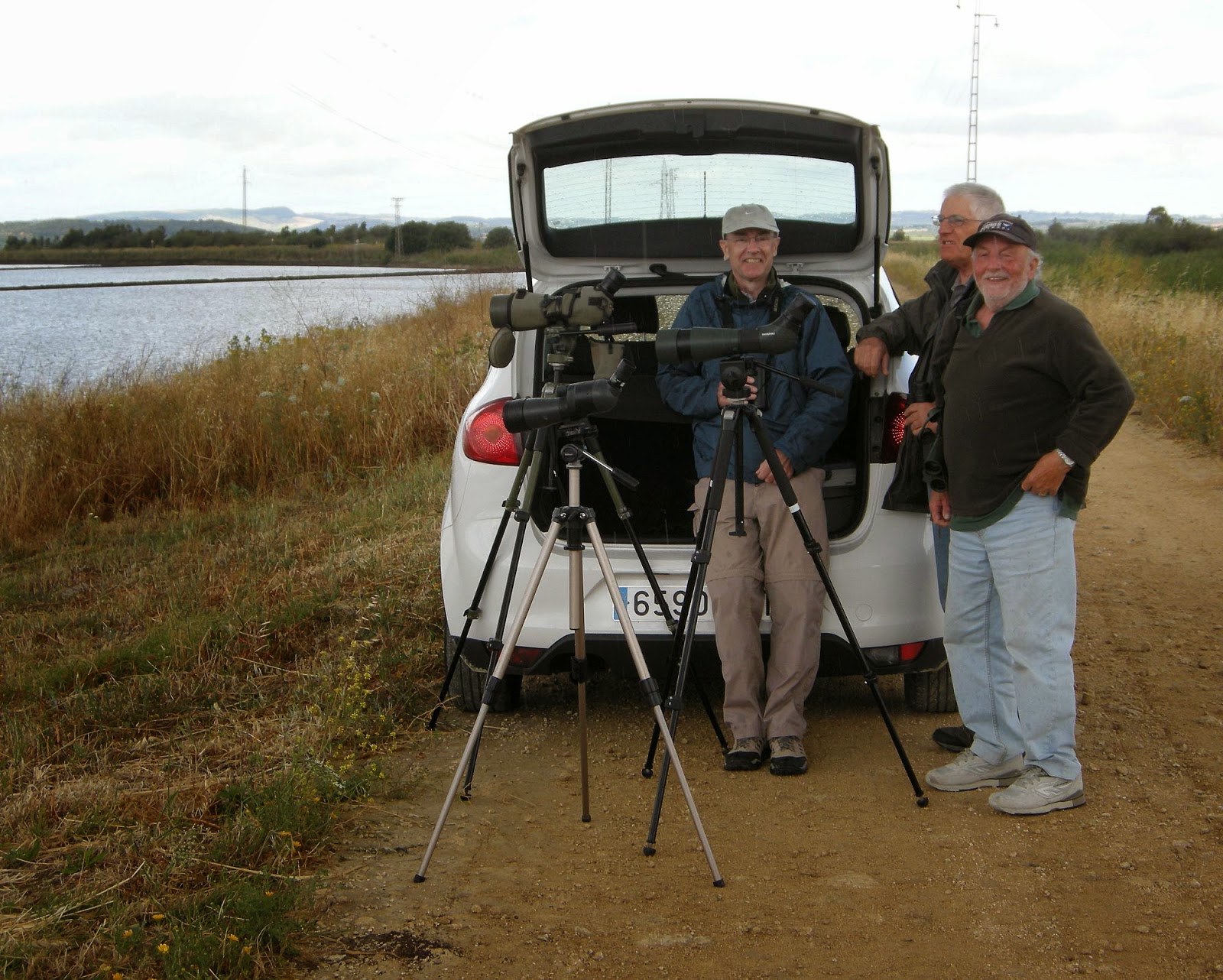
We drove on through a landscape dominated by dozens (if not hundreds) of wind turbines to the Embalse (reservoir) Almodovar, where on a rough track we dug out the chairs from the boot and sat and ate a picnic lunch. Bob told us to check out the surrounding mountain ridges for Bonelli’s eagle, but we were not lucky enough to spot any. The huge reservoir held yellow and white wagtails, grey heron, mallard and cattle egret. Mostly griffon vultures passing over, but the occasional short-toed eagle and honey buzzard. We watched aghast as a griffon vulture flew right through the arc of a huge wind turbine. It was not hit by the blade, but the air turbulence almost turned this enormous bird upside down.

Our next destination was the Barbate Marshes, a large area of shallow lagoons near the coast. We drove around these on the rough track, stopping at various spots to scan the lagoons with our ‘scopes. There was plenty to see, including some new species for our list. David found a stone curlew, and an osprey flew over. A good count of 49 spoonbill and 46 Audouin’s gull. A great white egret was apparently unusual for this spot. A long list of waders consisted of redshank, greenshank, black-winged stilt, dunlin, knot, sanderling, curlew sandpiper, ringed plover, Kentish plover, grey plover and avocet. As well as the Audouin’s there were also yellow-legged and lesser black-backed gulls.

We moved on to the bridge over the River Barbate in hope of finding Caspian terns. We did not find any of these, but better there were a couple of Lesser crested terns, a rare annual vagrant from Africa. They perched on posts on the far side of the river along with Sandwich terns, so we never managed to get a good close view.

Finally we drove to the coastal town of Bolonia and headed up to the mirador (view point) 300m up in the Sierra de la Plata. The view to the beach at Bolonia and over the Med to Morocco was quite spectacular. We settled down in the hope of seeing white-rumped swifts. The antics of the breeding griffon vultures high on the crags above us fascinated us while we waited for the swifts to show, and a lone blue rock thrush showed for a while. It goes without saying that the skies above had many passing raptors (honey buzzard, booted eagle, black kite) and dozens more bee-eaters. Sadly, the swifts did not show up.

We had dinner at a restaurant frequented by the Tarifa surfing crowd – the three of us were probably more than twice the age of any of the other clientele!

Bob's Day 6 Blog

Tarifa Autumn Tour – Day 3 Huerta Grande and Castillo de Castellar

Sun 6 Sep 2015

For our pre-breakfast walk we simply crossed the road to Los Lances beach. It was till too dark to see anything in the stone pine woodland behind the beach so we headed straight out onto the sand. Not a great deal about – just yellow-legged gull and sandwich tern. Wandering around the grounds of a hotel we spotted crested lark, feral pigeon, collared dove, house sparrows and linnet. We glimpsed a small brightly coloured parrot which we tried to follow around the hotel grounds. We eventually caught up with a small group of these, which turned out to be Love Birds (escaped cage birds). We had another look in the pine trees before returning for breakfast, managing to locate spotted flycatcher and short-toed treecreeper.

After breakfast we headed towards Jimena de la Frontera. We made an unplanned stop at a local privately owned nature reserve, Huerta Grande, where we had a guided tour by the proprietor. We spent 20 minutes in a hide overlooking a small pond and surrounded by feeders. We logged lots of serins and blue tit, great tit, common whitethroat, chaffinch, house sparrow, blackcap, garden warbler and collared dove.

As we chatted to the owner prior to departing a good raptor passage began to develop overhead. Booted eagles, short-toed eagles, griffon vulture and dozens of honey buzzard. We decided to go back to the Cazalla Observatory near Tarifa, but there were probably more bird watchers there than migrating birds!

Giving up on the raptor watch point we resumed our journey towards Jimena, stopping to eat lunch by the Rio Hozgargante. This sadly turned out to be rather disappointing as the river had almost completely dried up. Walking along the river bed we eventually came to a little water where we found Sardinian warbler, blue tit, nightingale, robin, blackbird, goldfinch and blackcap. A couple of griffon vulture passed over. We found evidence here of bird trapping. We spoke to an English lady who lived locally who told us that the authorities did very little to stop this illegal practice.

Next we drove the length of the Marchenilla Track. This proved a bit more interesting with sightings of woodchat shrike, little owl, wheatear, bee-eaters, stonechats, Montagu’s harrier, buzzard and red-rumped swallow. At the end of the track we stopped for a coffee break before retracing our route. On the second pass we added a black-eared wheatear.

We now aimed for Castillo de Castellar de la Frontera where we hoped to find white-rumped swifts. En-route we stopped by a bridge near Presa de Guadarranque to look for Monarch butterflies. We saw some, but they were far below us under the bridge. We stopped again at a high point overlooking the Embalse (reservoir) del Guadarranque to look for the two-tailed pasha butterfly. We got great close-up views of this magnificent species as one of them defended his territory against an interloper.

The Castillo was heaving with locals and tourists on this fine Sunday afternoon and it was difficult to find a place to park. The castle is perched high atop a hill giving extensive views of the surrounding countryside. We hung around for an hour or so but never spotted any white-rumped swifts, but there were quite a few raptors passing, and it was unusual to be looking down on many of them from our high vantage point. The only new species added was crag martins.

Bob's Blog of Day 3

Andalucia – Day 7 Sierra de las Nieves and Gaucin

Sat 31 May 2014

Sierra de las Nieves

As this was our last day in Spain, we decided to have a shorter day so that we could do some sight-seeing in Gaucin in the afternoon. We drove about 30km to the north-east to Sierra de las Nieves Natural Park. This is high up in the mountains; all of today’s birding was above 1,000m.

Our first stop was at an open picnic area near the entrance to the park. The first sighting was of a Hoopoe as we parked the car. Great tit and Long-tailed tit were a couple of common species that we had not ticked as yet this week. A Cuckoo called from the forest, and after a few moments searching we managed to get a view of it in our ‘scopes. A stone drinking trough was attracting many birds down to drink, notably Spotted flycatcher and Crested tit.

We drove on further into the park until the track became too rough for our hired Seat Altea to go any further. We continued on foot, firstly through woodland, and then through more open, rocky terrain. Blackcap, Robin and Bonelli’s warbler were singing and a fine Subalpine warbler showed well to David and me. A Griffon vulture and a Booted eagle glided over and at last we found a Peregrine. In some flatter heathland near a farmstead were Linnet, Corn bunting, Stonechat and Northern wheatear. Fledgling Dartford warblers sat on a wire fence begging food from their parents.

The track lead us higher into pine forest where we stopped by a small stream hoping to see birds coming down to drink. In the tall pines we found Firecrest, Nuthatch, Coal tit and, soaring over the canopy, our only Sparrowhawk of the trip.

Retracing our steps back to the car we saw the stonechats and Dartford warblers again, along with Melodious and Spectacled warblers. We drove back to the picnic area and had lunch at one of the tables.

On the drive home we stopped at the cafe high on the Ronda road again, hoping to see some eagles. All we managed to spot were a Short-toed eagle and Griffon vulture in the far distance.

Gaucin

Back in Gaucin the three of us wandered up to Castillo del Aguila (Eagle Castle) in the late afternoon sunshine. This medieval castle sits on a promontory above the village and we enjoyed magnificent views of the village and surrounding mountains, and down towards Gibraltar and the coast 40km away.  A nice relaxing way to end our birding tour of Andalucia.

See also Bob’s Wingspan blog for Day 7.

Today’s List

 
Griffon Vulture Eurasian Sparrowhawk
Booted Eagle Peregrine
Woodpigeon Cuckoo
Swift Hoopoe
Woodchat Shrike Jay
Red-billed Chough Coal Tit
Crested Tit Great Tit
Blue Tit Wood Lark (h)
Long-tailed Tit Western Bonelli’s Warbler
Melodious Warbler Blackcap (h)
Dartford Warbler Spectacled Warbler
Subalpine Warbler Firecrest
Wren Blackbird
Robin Stonechat
Northern Wheatear Black Wheatear
Spotted Flycatcher Chaffinch
Goldfinch Linnet
Corn Bunting Cirl Bunting
36 Species  
 
Click here for the week’s full list
            

This is the list of butterflies we saw during the week (compiled by Alan Strachan).

Scarce Swallowtail Large White
Small White Bath White
Clouded Yellow Berger’s Clouded Yellow
Black Veined White Cleopatra
Small Copper Lang’s Short-tailed Blue
Brown Argus Monarch
Painted Lady Grayling
Meadow Brown Gate Keeper
Spanish Gatekeeper Small Heath
Speckled Wood Wall Brown
Southern Gatekeeper Common Blue
Small Skipper Rock Grayling
Spanish Marbled White Red Underwing Skipper
Knapweed Fritillary Moroccan Orange-tip
Sage Skipper Large Tortoiseshell
Lulworth Skipper Queen of Spain Fritillary
Marsh Fritillary Dusky Meadow Brown
Dusky Heath Holly Blue
Brimstone Large Skipper
Small Tortoiseshell Adonis Blue
Spanish Chalk Hill Blue Silver Studded Blue
42 Species  

Andalucia – Day 4 La Janda

Wed 28 May 2014

We travelled south-west today for some lower-level birding away from the mountains. The day started wet and windy, but it did improve later.

Marchenilla Track, Near San Pablo

This dusty country road is only 10km from Gaucin and was visited specifically for Rufous bush robin and Tawny pipit. We spotted two Little owls en-route and, more excitingly, a couple of Black-winged kite flew across the road in front of us. Sadly not a great view, we only really saw the birds in silhouette gliding with their wings held in their characteristic deep V-shape.

After parking the car we began a gentle walk along the track and it wasn’t long before the target Rufous bush robin appeared. What a cracker, and our luck got even better when a second bird showed. An unusual looking sparrow sat on a fence caught my eye. Bob identified it as an Italian sparrow; a Spanish/house sparrow hybrid, considered by some authorities as a separate species.

A bit further along we found our second target species, Tawny pipit. This also afforded us good views from its perch on electricity wires. A small flock of Bee-eaters could be seen in a tree across the fields, and a fine Melodious warbler showed on a fence. Notable birds that did a fly past were Short-toed eagle, dark morph Booted eagle, Buzzard and White stork.

Tarifa – Playa de los Lances

We had to put on our waterproofs here as it was raining as we parked up. As we walked along the boardwalk out to the beach front hide Short-toed lark performed their short song flights, but there was not much else about on the beach, only a few Yellow-legged gull, Ringed plover, Kentish plover, Dunlin and Little egret. After twenty minutes we gave up because of the horrible weather and went for a coffee in a nearby hotel.

La Janda

It continued to rain quite heavily as we drove on to La Janda, but the worst had passed by the time we arrived. This is a large wetland area, but much of it has been “improved” for rice growing. We drove slowly along a track with flooded fields on either side. Lots of Cattle and Little egrets, Glossy ibis and White stork. We got out of the car to scan across an area of water with our ‘scopes and added Night heron, Spoonbill, some distant Collared pratincole and an even more distant Marsh harrier. An Egyptian mongoose ran across the track in front of us.

The road turned right to continue in a straight line for a few hundred metres. The white poplar trees along the left hand side were full of nesting Cattle egrets – hundreds of them. The car became a mobile hide allowing us great close views of them. Many Glossy ibis were also nesting amongst the egrets . A fantastic sight!


Once beyond the egret/ibis colony we stopped to eat our sandwiches, the rain having now cleared away. Reed and Cetti’s warblers were singing from somewhere in the bushes and Turtle doves sat on wires.

We drove onwards until we arrived at a few farm buildings were we stopped to look at half-a-dozen Black kites soaring low over the farm. As we continued through the farm a Little owl sat very photogenicly on a gate post. We followed the track for another two or three kilometres past more lagoons and finally to a woodland where a pair of Spanish Imperial eagles are breeding, but no sign of them above the trees. We turned the car around and began to retrace our route. A group of large birds high to our left caught our attention. We stopped to check them out and amongst the Griffon vultures were two Spanish Imperial eagles. An exciting find.

As we drove back through the farm the Little owl was back on its perch and obligingly allowed us to take more photographs. We followed the track back past the Cattle egret/Glossy ibis and finally out onto the main road. An ocelated lizard (one of the larger species) scuttled across the track at the end of the track.

Vejer de la Frontera

We called into this small town specifically to see the nesting colony of Bald ibis on rocky cliffs right next to the road. There were several well grown youngsters in the nests as well as the adults. But my, what an ugly bird!

Barbate Marshes

A large shallow lagoon near the coast that held Kentish plover, Spoonbill, Black-winged stilt, Lesser black-backed gull, Yellow-legged gull, Grey plover, Greater flamingo, Avocet and Little tern. We had excellent close views of Collared pratincole as they stood on the sandy track. Calandra lark, Stone curlew, Short-toed lark, Crested lark and Yellow wagtail (blue headed variety) were nice species in the surrounding grassland.

Mirador del Estrecho (Near Tarifa)

We stopped at this viewpoint to check if any late migrants were flying in from Africa. We did not see any, but the views across the Straits of Gibraltar to Morocco were very impressive.

Gaucin

Ended the day being serenaded by the Blue rock thrush singing from the rooftops of Gaucin.

See also Bob’s Wingspan Blog for Day 4.

Today’s List

 
Pheasant Mallard
Greater Flamingo White Stork
Northern Bald Ibis Glossy Ibis
Eurasian Spoonbill Black-crowned Night Heron
Cattle Egret Grey Heron
Little Egret Black-winged Kite
Black Kite Griffon Vulture
Short-toed Eagle Marsh Harrier
Common Buzzard Spanish Imperial Eagle
Booted Eagle Common Kestrel
Moorhen Stone-curlew
Black-winged Stilt Pied Avocet
Grey Plover Ringed Plover
Kentish Plover Dunlin
Collared Pratincole Yellow-legged Gull
Lesser Black-backed Gull Little Tern
Turtle Dove Little Owl
Swift European Bee-eater
Great Spotted Woodpecker Woodchat Shrike
Jackdaw Calandra Lark
Short-toed Lark Crested Lark
Skylark Barn Swallow
House Martin Cetti’s Warbler (h)
Reed Warbler Melodious Warbler
Zitting Cisticola Sardinian Warbler
Blackbird Nightingale
Rufous Bush Robin Stonechat
Blue Rock Thrush House Sparrow
Italian Sparrow Yellow Wagtail
Tawny Pipit Serin
Greenfinch Goldfinch
Linnet Corn Bunting
64 Species  

Andalucia – Day 3 Mountains South-west of Ronda

Tues 27 May 2014

We headed off towards Ronda for today’s birding. A short stop to check out a Rock sparrow sat on the roadside wall also produced a Subalpine and Melodious warbler. At a second stop we found a Black wheatear high up on the crags above the road and a Red-rumped swallow swooped below us.


Encinas Borraches Track

The track at Encinas Borraches was the first planned location. Bob intended this to be a visit of about an hour, but it we found such good birds here, we ended up staying for three. 

Both Crested and Thekla lark were bagged before we had even opened the gate to start walking the track. A few minutes scanning the area near to the farm buildings/pond produced Stonechat, Corn bunting and Little owl, but no sign of Southern grey shrike that Bob expected to find here. Red deer were high up on the rocky hillside.

A Black-eared wheatear was the first of several new species for me – a very fine looking bird. The sweet song of a Woodlark caught our attention, but it was some time before we eventually spotted the bird. A Cuckoo called from somewhere further down the valley and a Woodchat shrike perched in the top of shrubs. More mundane birds were Stonechat and Red-legged partridge. Black-veined white and Sage skipper butterflies excited Alan. The next new tick for me was Spectacled warbler; not just one, but a family party flitting around in some low shrubs. As we continued along the track two more warbler species were heard and eventually seen after some patient waiting - a Western Orphean warbler (another new tick for me) and Subalpine warbler. A Western Bonelli’s warbler was the last bird added before we turned to walk back. Golden oriole and Hoopoe were heard but not seen.


As we walked back David spotted a bird sat on a distant pylon which at first we thought was a Blue rock thrush, but once we had it in our ‘scopes we realised it was a Rock thrush - the find of the day. Nearing the car we at last found the Southern grey shrike that had eluded us earlier. After scoffing our sandwiches back at the car an interesting assortment of butterflies that were finding something nutritious on a cow-pat by the gate caught our attention.

Ronda

We moved on and stopped for coffee at a high mountain road which was allegedly a good spot for eagles. We sat with coffee for half-an-hour but did not see any eagles.

Bob left us in Ronda for twenty minutes of sight-seeing at the bridge, from where we found Chough, Pallid swift, Lesser kestrel, Feral pigeons and admired the wonderful views.

Montejaque Cork Woods

We pressed on to a cork oak forest near Montejaque. Firecrest was the best find here, and a red deer paddling in a small lake, which soon took cover in the trees when it spotted us. We looked carefully for Treecreeper, but without success.


Llanos de Libar

We headed up into a high mountain valley at Serrania de Ronda/Llanos de Libar for the final birding of the day. Rock bunting was the target species. At the first place we stopped only for five minutes as it was very windy, seeing only Griffon vulture, Corn bunting, Goldfinch and Sardinian warbler.

We moved a little further and higher and found Blue rock thrush, Black redstart and a Spanish ibex that looked down on us from the summit of a mountain across the valley. A Short-toed eagle flew over, as did a Raven. As we drove back down the mountain road we found Rock sparrow and Linnet drinking at a tiny pond and Black-eared wheatear perched on a lichen covered rock. Rock bunting remained elusive.

Fine views of the local Blue rock thrush on the rooftops of Gaucin in the evening.

See also Bob’s Wingspan blog for Day 3.

Today’s List

 
Red-legged Partridge Griffon Vulture
Short-toed Eagle Lesser Kestrel
Common Kestrel Rock Dove / Feral Pigeon
Woodpigeon Cuckoo
Little Owl Swift
Pallid Swift Kingfisher
Hoopoe Southern Grey Shrike
Woodchat Shrike Golden Oriole
Red-billed Chough Common Raven
Crested Lark Thekla Lark
Wood Lark Barn Swallow
Red-rumped Swallow Western Bonelli’s Warbler
Melodious Warbler Western Orphean Warbler
Spectacled Warbler Subalpine Warbler
Firecrest Blackbird
Nightingale Black Redstart
Stonechat Black-eared Wheatear
Black Wheatear Rock Thrush
Blue Rock Thrush Spotted Flycatcher
House Sparrow Rock Sparrow
Chaffinch Serin
Goldfinch Linnet
Corn Bunting  
45 Species  

Andalucia – Day 2 South to Algeciras

Mon 26 May 2014

I awoke to the song of a Blue rock thrush, and once I had washed and shaved, I took a cup of tea out onto the roof terrace and saw this handsome thrush sat on a nearby chimney (starting the day with another new species for me).

Near Gaucin

After breakfast in Bob’s house we headed off for the first full day’s birding. We pulled off the road just outside Gaucin to look at some birds of prey that had caught our eye – three Honey buzzard on their northward migration. In the distance towards Gibraltar another large bird was picked out in binoculars. We thought it might be a Black stork, but we could not locate it again in our ‘scopes.

A little way further from Gaucin we spent a pleasant hour walking along a track by the shallow Rio Genal. More Honey buzzard were flying over as we began and we heard Nightingale and Turtle dove. Male and female Blackcaps showed well, and down by the water both Grey and White wagtails were seen. From the finch family we saw Chaffinch, Greenfinch and Serin and of warblers Sardinian and Cetti’s. We spent a while observing a couple of interesting butterflies. A Jay flew across the river and a Golden oriole, initially heard singing, eventually showed itself as it flew between trees. More birds of prey – Buzzard, Short-toed eagle and dark morph Booted eagle. The drumming of a Great spotted woodpecker came from not too far away and finally a Raven circled high above us.

River Guadiaro

We drove on, heading for the River Guadiaro, but we stopped a couple of times before getting there to see Crested lark, Woodchat shrike, another pale morph Booted eagle and possibly a Thekla lark.

At the River Guadiaro things were a little quiet. A Turtle dove and a Bee-eater sat close together on a wire in the distance on the other side of the river. A few Swallows made some low-level passes over the water and on the exposed shingle were one or two Little-ringed plover. Bob called an Alpine swift, but I am not sure if anyone else managed to spot it. A pale morph Booted eagle circled overhead giving some superb views. A Bath white butterfly was also a nice find. Goldfinch, Greenfinch, Corn bunting and Stonechat were added as we strolled back to the car, along with a fine female Sardinian warbler.

We moved a short distance to another spot on the same river, stopping en-route to try to get a better view of an Egyptian vulture. Unfortunately it disappeared behind a low hill not to be seen again.

The target species at this section of the river was Western Olivaceous warbler, as this was a known breeding site. Nightingale and Cetti’s were heard, and a small flock of Yellow-legged gulls lazed on a spit of shingle in the river. A likely scratchy warble from a low bush turned out to be a Sardinian warbler. Little egret, Common sandpiper and Little-ringed plover sat on the opposite bank of the river. After a some time searching we eventually found and had a good view of the Western Olivaceous warbler (listed as Isabelline warbler by some sources). Other species seen were Cirl bunting, Serin and White wagtail.

San Enrique Woods

We moved on to San Enrique Woods where we munched our sandwiches stood by the open boot of the car. Alan mentioned that that he would very much like to see a Wryneck, and no sooner had he said this than one began calling nearby. It almost immediately appeared and perched, continuing to call, above us. It moved back and forth between two trees, calling excitedly all the time, and allowing us great views. A griffon vulture cruised past and we found tree sparrows from the nearby breeding colony. A Monarch butterfly wafted around in a clearing. Once we had finished our lunch we walked a short distance into the deciduous wood, consisting mainly of white poplar. Here we saw jay, a family party of Spotted flycatcher, Chaffinch and White wagtail and heard Hoopoe and Great spotted woodpecker. We failed to find Short-toed treecreeper, though we thought we heard one.

Pinar del Rey Pinewoods

There were lots of White stork sitting in the nests on various poles and pylons as we travelled on to our next destination, Pinar del Rey pinewoods. Chaffinch, Blackcap and Bonelli’s warbler were heard and eventually spotted. Crested tit was another nice find. I located a small warbler whose song include phrases similar to a Chiffchaff, but with additional non-chiffchaff motifs. Bob identified this as an Iberian Chiffchaff. A scratchy warble that sounded a bit like a Whitethroat, though longer, was another Sardinian warbler. Finally, a Cleopatra butterfly was added to our insect list.

Polmones

The day’s last stop was at Polmones beach (near Algeciras). Not many species added here, but Kentish plover on a sand bar about 100m offshore was a good one. On the same sand bar were Black-headed and Yellow-legged gulls, Sandwich tern, Little plover and a blue-headed (Iberian race) Yellow wagtail.

On the journey back to Gaucin we stopped to look at a Lesser kestrel nest site in the structure of a railway bridge. One of the birds was on a telegraph wire, but it flew off as we drove past. We did see a couple of the birds in the distance, and one disappeared into the nest hole but did not not re-appear. A Melodious warbler showed briefly in the hedgerow.

See also Bob’s Wingspan blog for Day 2.

Today’s List

 
Mallard Little Grebe
White Stork Little Egret
European Honey Buzzard Egyptian Vulture
Griffon Vulture Short-toed Eagle
Common Buzzard Booted Eagle
Lesser Kestrel Common Kestrel
Moorhen Ringed Plover
Little Ringed Plover Kentish Plover
Common Sandpiper Black-headed Gull
Yellow-legged Gull Sandwich Tern
Woodpigeon Turtle Dove
Swift European Bee-eater
Hoopoe Wryneck
Great Spotted Woodpecker Woodchat Shrike
Golden Oriole Jay
Common Raven Crested Tit
Great Tit Blue Tit
Crested Lark Thekla Lark
Barn Swallow Cetti’s Warbler
Iberian Chiffchaff Western Bonelli’s Warbler
Western Olivaceous Warbler Melodious Warbler
Zitting Cisticola Blackcap
Sardinian Warbler Spotless Starling
Blackbird Robin
Nightingale Stonechat
Blue Rock Thrush Spotted Flycatcher
House Sparrow Tree Sparrow
Yellow Wagtail Grey Wagtail
White Wagtail Chaffinch
Serin Greenfinch
Goldfinch Corn Bunting
Cirl Bunting  
63 Species  

Andalucia – Day 1 Malaga and Gaucin

SUN 25 MAY 2014

After a early flight, Alan, David and I arrived at Malaga airport for a week’s bird watching in Andalucia, led by Bob Buckler of Wingspan Bird Tours. Once we had found Bob we all piled into his car and drove the short distance to an area of waste land near Guadalmar to get straight on with the birding.

Guadalmar

Target species were Hoopoe and Bee-eater, and both were found within a few minutes in the trees on the opposite side of the small river. Spotted flycatcher and Turtle dove were found in the same trees, and Barn swallow, House martin and the odd Red-rumped swallow swooped over the river. A new species for all of us was Monk parakeet – a non-native South American species. Alan noted a few butterflies including small skipper and clouded yellow, and a hummingbird hawk-moth was also spotted. Gulls were of the yellow-legged variety and Spotless starling, Swift, Crested lark, Jackdaw and Kestrel completed the list.

Guadalhorce Natural Park

We drove on a short distance to the Guadalhorce Natural Park, named after the river that flows on two sides of this triangle of land next to the Med. Collared dove and House sparrow were unspectacular starters for the list. On the water were Coot and Little grebe, and above, Whiskered tern patrolled along the river. From the bridge the unmistakable song of a Cetti’s warbler exploded in the air and the bird then flew a short distance along the river bank. The monotonous zip zip song of a Zitting cisticola punctured the air. A high point overlooking a shallow lagoon produced Spoonbill, Little egret and a couple of pairs of White-headed ducks. A Reed warbler was singing nearby. As we walked on towards another lagoon, more Bee-eaters and Monk parakeets flew over. From the screen at the next lagoon were added Black-winged stilt, Pochard, Yellow-legged gull and Gull-billed tern. Amongst the swifts chasing insects over the water was at least one Pallid swift. The final area of water produced Little tern, Avocet, Sanderling, Ringed plover, Dunlin, Whimbrel, Mallard and Red knot. As we made our way back to the car, final species bagged were Serin and Red-rumped swallow.

Crestellina and Gaucin

As it was now getting on for 3.00pm it was high time we made a start on the journey to the town of Gaucin; Bob’s home and our base for the trip. After an hour’s travelling, we turned-off the excellent A-7 onto the twisting and turning A-377 for the  20km climb up to Gaucin, nestled high (640m) in the mountains. We pulled up under the long ridge of Crestellina to watch the Griffon vultures soaring above the mountain. The distinctive chow call alerted us to the Red-billed chough  also present on the crags. A pair of Bonelli’s eagles breed on this mountain, but they were feared not to have been successful this year. Looking at the eyrie through our ‘scopes we were able to prove otherwise, as a large chick could clearly be seen patiently waiting for its parents to return. The adults were soaring around with the vultures, probably today’s star birds.

The road steepened and became more twisting as we got closer to Gaucin, and when at last we had finished the ascent and the town was spread in front of us a bird of prey caught our eye circling above the town. It had a snake in its talons so we pulled off the road to have a good look. A Short-toed eagle, of course, and as we watched it transferred the unfortunate reptile form its talons to its beak – no doubt destined to be a meal for its youngsters.

We had done little more than four hours birding since our arrival, but this had produced 48 species (including seven news ones for my life list), so a great start for our Spanish adventure.

See also Bob’s Wingspan blog for Day 1.

Today’s List

 
Mallard Pochard
White-headed Duck Little Grebe
Eurasian Spoonbill Little Egret
Griffon Vulture Short-toed Eagle
Bonelli's Eagle Common Kestrel
Eurasian Coot Black-winged Stilt
Pied Avocet Ringed Plover
Little Ringed Plover Whimbrel
Red Knot Sanderling
Dunlin Yellow-legged Gull
Gull-billed Tern Little Tern
Whiskered Tern Turtle Dove
Collared Dove Monk Parakeet
Swift Pallid Swift
European Bee-eater Hoopoe
Red-billed Chough Jackdaw
Crested Lark Barn Swallow
House Martin Red-rumped Swallow
Cetti’s Warbler Reed Warbler
Zitting Cisticola Spotless Starling
Blackbird Stonechat
Spotted Flycatcher House Sparrow
Serin Greenfinch
Goldfinch Corn Bunting
48 Species  

Hungary Day 2 – Warblers and Woodpeckers

Mon 6 May 2013

Near Noszvaj

Our day started with a short drive from the hotel for a pre-breakfast woodland walk. The song of a barred warbler was briefly heard as soon as we got out of the minibus, but we did not find it. Nightingale and cuckoo soon followed. Our first yellowhammer and hawfinch were found, but as is usual in woodland, birds were easier to hear than see. We did manage to find turtle dove, golden oriole, red-backed shrike and a hobby that flew over. The call of wryneck came from deep within the woods, and for the only time during the week we heard the call of a grey-headed woodpecker.

The barred warbler was still singing back at the minibus, but it started to rain as we were looking for it, so we abandoned the search and returned to the hotel for breakfast.

Ostoros

After breakfast, with the weather now clear, we visited Ostoros  about 8km to the south-east of Eger. This was an open, grassy area with a few reeds and adjacent woodland.

A marsh warbler was singing low down in the reeds and we spent some time trying to find it. Some were lucky enough to see it as it moved around amongst the reed stems, but it eluded many. Walking on along a track with grassland on our left and woodland to the right, the continuous song of a river warbler came from the grassland. The song is similar to a grasshopper warbler, but with a chugging rhythm like an old steam train. Although we looked hard, we did not find the bird. A whitethroat delivered its scratchy warble from a shrub beside the track and occasionally circled around on a song flight.

Southern festoon and Hungarian glider butterflies were on the wing as we moved into the woodland, where we saw the only willow warbler of the trip. There was not a great deal found amongst the trees, so we made our way slowly back to the minibus. Determined to find the singing river warbler, I spent some time searching with my ‘scope in the area where the sound appeared to be coming from. Success! It was in a short, leafy tree about 1m off the ground and could be seen well. Only David and Graham saw it with me, as the group had split up as we made our way back. For the five minutes we stood watching it never moved from its perch.

We caught up with Steve to tell him about the river warbler, but he trumped it with a penduline tit! But it had now gone, chased off by a red-backed shrike. A shame to have missed it, but you can’t have everything!

Before climbing back into the minibus we spent a few minutes trying to find that marsh warbler again. Glimpses of it were the best we could get, but it was singing well at times with blackbird featuring heavily in its song. The unmistakable loud song of a great reed warbler was also heard close by.

Coffee Stop

As it was now late morning, it was time to find some coffee, and this was provided at a rather smart restaurant/hotel in Zsórifürdő, near Mezőkövesd. A pair of blackbirds were busy bringing food to their chicks in a nest in the garden, and swift, swallow and house martin swooped around overhead. A puddle in the car park was a popular bathing place for serin, goldfinch, linnet, greenfinch, chaffinch and house sparrow. Steve, Brian and Shelagh found a rather nice wood warbler nearby.

Wood warbler at Zsórifürdő, near Mezőkövesd    Linnet, goldfinch and serin at Zsórifürdő, near Mezőkövesd

Old Russian Airfield, Mezőkövesd

Walking around the overgrown scrubland at this long since abandoned Russian airfield we had great views of four golden orioles as they flew around in the treetops. A tree pipit was singing (and seen) at the same spot. As we walked a bit further we found spotted flycatcher and a blackcap and heard nightingale, green woodpecker and wood warbler.

Roy led us to a clearing that he knew was good for woodpeckers. After five or ten minutes of patiently waiting we were lucky enough to catch sight of a lesser spotted woodpecker as it darted into its nest hole half way up a dead tree stump. It remained in the hole, poking out its red-capped head (indicating a male) every now and then. After a while in emerged from the hole and and perched out to give us good views.

Returning to the minibus we saw hobby and tree sparrow, and a large bird of prey in the distance. Although it was a long way off, Roy could identify it as an Eastern Imperial eagle. A nice addition to our list, even if it was too far away to see in detail.

Back in the minibus we drove along the runway looking for tawny pipits. We heard corn bunting and saw a whinchat. Peter spotted a pipit on a small tree. It was very pale in colour and seemed quite large, so this could have been a tawny, but as we did not stop we did not get good enough views to be certain.

Lunch Stop (Unknown location)

Whilst the others lunched inside, Steve and I continued birding. Nothing new, but a distant bird of prey was interesting. I spotted it in flight and it looked eagle-like to me, gliding with its wings held horizontal. It landed it the top of a tree about 2km distant. We could see that it was long-legged, but from such a distance we could not make out much other detail. We observed it for five minutes, but while we were looking at another possible interesting bird a bit closer it moved off without us noticing. It remained un-identified.

Fish Ponds (Unknown location)

We saw white stork whilst travelling to this next site. They are common, with many of the concrete telegraph poles in the villages having frameworks fixed to the top for them to build their nests on.

Great Reed WarblerThe unmistakably loud song of great reed warbler greeted us on arrival at the fish ponds, and the bird was immediately obvious at the top of some reeds. The many posts standing in the water each had a whiskered tern sat on them. I always find it tricky to identify marsh terns, but Roy’s tip was that whiskered are the grey terns with a common tern’s face pattern. Learning how to separate black from white-winged would come later in the week.

Four cuckoos were chasing each other around, a great crested grebe was on the water and a great egret at the water’s edge. Hobby and marsh harrier flew over, and grasshopper and Savi’s warblers were singing. Brenda thought she saw treecreeper.


Lewis came to warn us that he had heard on the radio that there was a thunderstorm over Budapest with golf-ball sized hailstones, and it was heading our way. We did not want to get caught out in it.

Near Mezőcsát

Now on the way back to the hotel because of the impending storm, roller perched on wires was found near this village. A passing farmer informed Roy that he had hoopoe around his farm (in fact, most of the farms have a resident hoopoe), so we walked across the grassland toward the farm in the hope of finding it/them. No luck, but we did find wheatear, black redstart, tree sparrow, skylark, swallow, feral pigeon and a splendid yellow wagtail (blue-headed race).

With the storm getting closer, prudence dictated that we called it a day and returned to base. The rain and lightning began as we travelled home, and the thunderstorm continued into the early hours of the morning.

Species Added Today

Pheasant (h) Great Crested Grebe
Eastern Imperial Eagle Hobby
Green Woodpecker (h) Lesser Spotted Woodpecker
Grey-headed Woodpecker (h) Tawny Pipit
Tree Pipit River Warbler
Marsh Warbler Great Reed Warbler
Barred Warbler (h) Whitethroat
Willow Warbler Penduline Tit
Greenfinch Hawfinch
Yellowhammer  
19 Species