Sun 09 May 2010
After last year’s successful trip to the Brenne, David, Alan, Chris and I eagerly set off for a repeat trip to the same area. The first leg of the journey was an evening drive down to Portsmouth to catch the 22:45 ferry to Ouistreham. This was a change of plan as originally we had booked the following morning’s sailing to Cherbourg, but this had been cancelled at short notice. Sadly, this meant no sea-watching to kick start our list. After a cuppa in the restaurant we adjourned to our cabins in the hope of getting some sleep before the early morning start.
Mon 10 May 2010
We rose early for breakfast at 5.00am, then down to the car deck ready to disembark. Once off the ferry we soon had our first bird – a herring gull! The early start gave us the opportunity to visit a couple of sites in Normandy before the drive south to the Brenne, so our first destination was the museum at Utah Beach.
The monotonous “dzip… dzip… dzip…” song of a fan-tailed warbler could be heard coming from the bushes next to the car park. The bird was difficult to locate, but eventually it gave a brief display. The beach was devoid of birds, probably because of the sand-storm being whipped up by the wind. We moved a couple of kilometres along the coast to the Beaugillot Nature Reserve. An hour or so’s birding here found, amongst others, great white egret, black swan, marsh harrier, and a small flock of spoonbill. A coypu was in front of one of the hides.
Next, a short drive to the nearby Ponts D’Ouve reserve. Sadly no sign of any bluethroats, but we did manage to get a brief glimpse of a Cetti’s warbler as it flew across the river. A white stork was in its nest with young, a grasshopper warbler was heard, and another spoonbill was seen from the hide. Raptors included hobby, marsh harrier and kestrel.
The journey south was quite long, but fairly straightforward as it was mostly on motorways (A28/E502, A10/E05), which were very quiet compared to British motorways. A short rest stop at Alençon services for fuel and coffee and then we continued on our way. The only bird of note seen on the journey was a harrier, but from the car we could not be certain whether it was a Monty’s or hen.
As we neared Champ d’Oeuf David remarked that a clearing on the D14 through the Forêt de Preuilly looked an ideal place for nightjars (more on this later).

As last year, we were staying at La Confiance, owned and run by Sue and Chris Mooney. Sue was there
to greet us as we arrived, and as we unloaded the car a nightingale burst into song to greet us as well.
There was plenty of time to sort out our things and have a shower before walking around to Sue and Chris’s dining room for our four-course dinner.
Tues 11 May 2010
A short walk around the lanes of Champ d’Oeuf before breakfast found turtle dove, melodious warbler and a singing nightingale. After we had all breakfasted the first destination was the Chérine Nature Reserve near St. Michel-en-Brenne for a meeting with Tony Williams. He has lived and worked in the area for many years and is the best source for all the latest info. Although it is only a short drive, it took longer than expected as every “bird on wire” had to be investigated, and a marsh harrier held us up for several minutes. We had a good sighting of a water rail from the viewing window in the visitor centre whilst waiting for TW, and Alan spotted a reed warbler. Also black tern, little egret and marsh harrier.
TW’s info included the news that there were black woodpeckers nesting in a pine tree next to the restaurant at Étang de Bellebouche, so that was added to today’s itinerary. Also that the bee-eaters were no longer at Néons-sur-Creuse but had re-located to nearby Tournon-St-Martin.
The rest of the morning was spent thoroughly exploring the area around Chérine. First the Tower Hide at the north-east corner of Étang Ricot. Nightingale and blackcap were singing well in the wooded area surrounding the car park and a golden oriole was heard from the hide. Common tern, marsh harrier and black kite were also seen from the hide.
A few hundred metres further along the D17 there is a small parking area overlooking Étang de Monmélier. There was not much on the water, but a black-winged stilt flew over. (Note for next time: There is a track starting here that leads past Étang Miclos – this is worth checking out).


A purple heron was seen on a quick visit to the southern end of Bellebouche and a very pale, hovering bird of prey that I at first mistakenly thought was an osprey. It was in fact our first short-toed eagle.

We had worked up quite an appetite from our day’s birding, so the delicious four-course dinner which Sue and Chris had prepared for us back at La Confiance was well received. A calling tawny owl was the only addition to our list on a short evening walk around the lanes of Champ d’Oeuf.
Wed 12 May 2010
Our pre-breakfast recce found a pair of stone curlews in a field not 200m distant from our gîte. Today was to be bee-eater day, and despite TW’s advice, we decided that we would check out the site at Néons-sur-Creuse first.
En-route we stopped for a few minutes at Étang Bourreau, a small lake alongside the D50. Lots of swallow, house martin and whiskered tern about, and a male harrier at first thought to be a Montagu’s, was quartering the fields in the distance. Closer inspection identified it as a hen harrier. A red-backed shrike appeared on a wire as we were leaving.

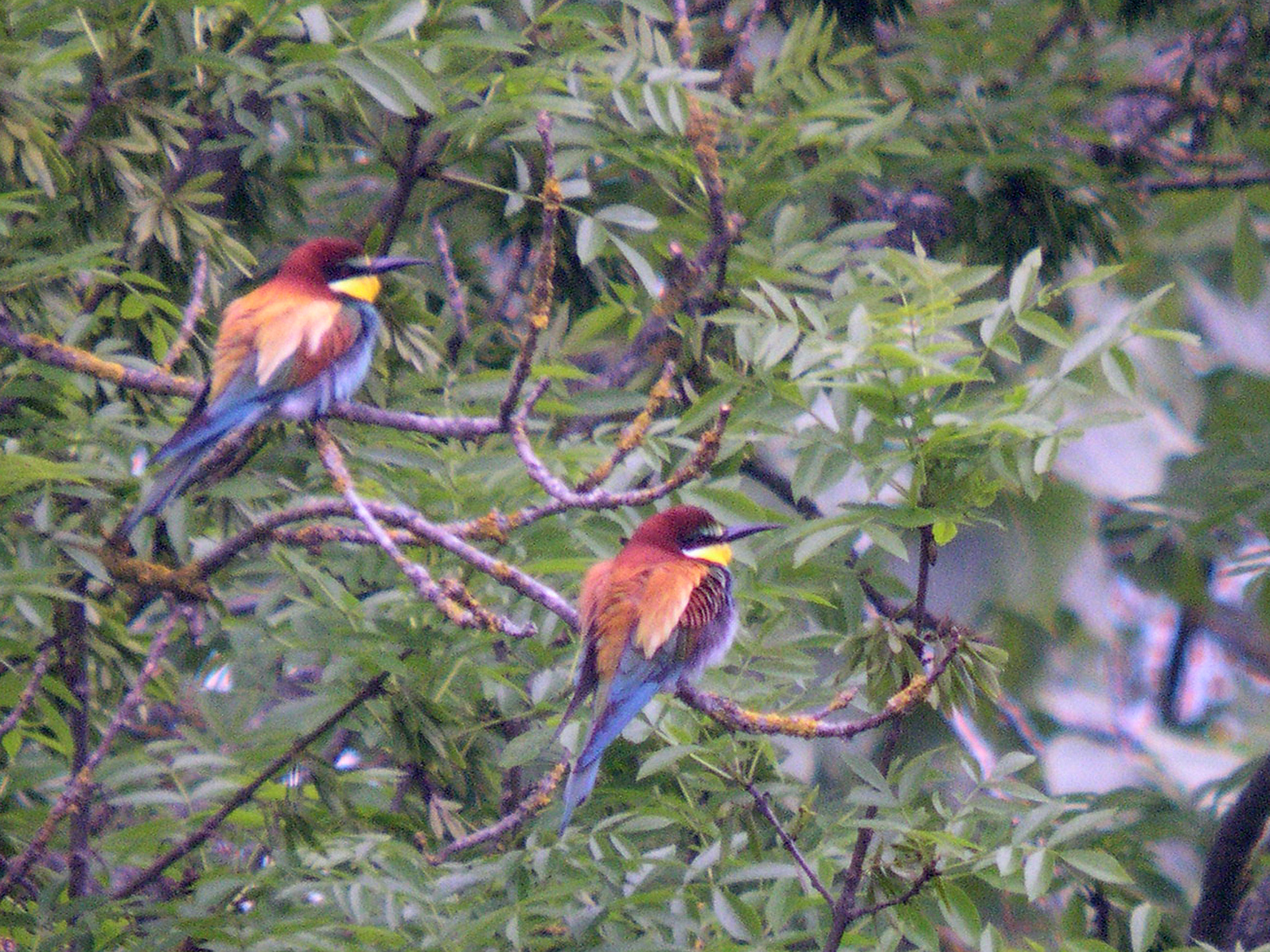
We watched them for a good twenty minutes before deciding it was time to move on. As we had now bagged the bee-eaters there was no need to go to Tournon-St-Martin so we headed for Étang de la Mer Rouge. Here we found another red-backed shrike and had good views of a booted eagle. More whiskered tern and a nightingale was heard (not unusual, as we heard these almost everywhere we went). A hornet was also encountered here.
En route to La Gabrière a possible peregrine flew over, and on the étang itself our first black-necked grebes. Black kite and booted eagle flew over as we viewed the lake from the roadside benches.
Making our way to Étang de la Sous we stopped to get a better view of a short-toed eagle which flew over. Butterfly orchids were growing on the verge here. A very impressive new hide had been constructed at Étang de la Sous and from it we saw great white egret, whiskered tern and purple heron. European pond tortoise (very common in the area) was also noted. A great reed warbler began singing from the extensive reed beds in front of the hide and we eventually located it and had a fairly good view for several minutes before it disappeared deep into the reeds. On returning to the car we found a tick on the dashboard. Chris made sure to keep her trousers firmly tucked into her socks after that.
A visit to the hide on Étang Massé at Le Blizon was not very productive. (Note for next time: there is a track here that runs by Étang du Blizon which would be well worth exploring).
Another brief visit to the Étang de Monmélier specifically to find black-winged stilts, which was successful. Yet another short-toed eagle flew over.
The final destination for today was an exploration of the lanes to the south-east of Azay-le-Ferron, where little bustards used to be found. Local knowledge is that they are no longer here, but we thought it was worth a look. On the D18 1km south-west of St-Julien a couple of Montagu’s harriers were seen being mobbed by curlew, but sadly no sign of any little bustards.
Whilst having our evening meal with Sue and Chris we were delighted to see a nightingale on the lawn of La Confiance.
Thu 13 May 2010
The customary pre-breakfast walk found nothing new, but it was a surprise to see a stone curlew take-off from a pasture with grazing cattle. Today’s itinerary was to explore the forests (mainly for woodpeckers) in the morning, and in the afternoon to have a guided orchid walk. A new species for our list was added on the way to the forest - greylag goose at Étang de la Bienaise. Several cattle egret were spotted in a field on the D21 near Bellebouche.
We drove deep into the Forêt de Lancosme, parked where five forest roads meet and walked along a forest track. Spotting birds was difficult because of the dense foliage, but Bonelli’s warbler and crested tit were seen well. Wood warbler, garden warbler and a treecreeper (the standard Eurasian type) were heard, and a brief glimpse of a golden oriole as it flew across the ride. We spent several minutes trying to locate a bird with an unusual song. We eventually found the culprit – a blackcap. It was an very un-blackcap like song though, it sounded more like a redstart.
 We moved on to the nearby chapel of St.Sulpice for another wander through the woods. Nothing new found, but a treecreeper was heard (this one sounded like the short-toed variety). We were pleased to find a chequered skipper butterfly, a species that can only be found around Fort William in Britain. Sadly, the only woodpecker noted today was the call of a great spotted.
 After returning to Champ d’Oeuf for a spot of lunch we headed off to Preuilly-sur-Claise to meet Susan Walter, an Australian naturalist living in France, and her partner Simon Brand, who were going to give us a guided orchid walk. We rendezvoused in the centre of the village, and after a brief introductory chat in the Hôtel de L’Image we made the short journey to their orchard. Alan and Chris travelled in style in the beautifully restored 1953 Citroën Traction Avant owned by Susan and Simon.


Having located a suitable spot to park the car we returned to Champ d’Oeuf for an early dinner. We left at about 9.00pm when there was still plenty of daylight, and en-route we saw a male hen harrier and stopped to have another look at the pair of stone curlews we had found earlier.
Our chosen spot was on the D14 in the Forêt de Preuilly, and after parking the car just off the road we walked a short distance into the woods. We were now surrounded by about 2m high scrubby vegetation with taller trees interspersed. It was a cool, but calm evening and several cuckoos were calling from the surrounding forest. As the light faded a bird was seen on the ground about 50m away. We struggled to identify it in the fading light, but our best guess was a mistle thrush. We all had doubts about this as the bird seemed much too grey. Afterwards we decided this could have been a fieldfare, as the area is not too far from their summer range.
As we stood in silence several large animals were heard routing around in the undergrowth just a few metres away from us. We did not see them, and had no idea what they were. We think they could have been either badgers or wild boar.
We were all beginning to have doubts that the habitat was right for nightjars, but at about 10.30 we at last heard the first brief churring call. The churring continued on and off for the next half hour or so, gradually increasing in intensity, from at least two birds. Suddenly the churring stopped and the frog like “kru-it” call began. The bird was obviously now moving and David and Alan began to wave white handkerchiefs. Instantly a nightjar made a close approach to us and then proceeded to fly around our heads. Although the light was now very feint, there was sufficient to enable us to see the bird in silhouette. In fact, it was the best views any of us had had of the species. Satisfied with our night’s work we made our way back to the car, only to have another nightjar flying around our heads as we got back to it.
Fri 14 May 2010

We lost count of the number of buzzards we saw sitting alongside the motorway as we journeyed north. A short break at La Dentelle d’Alençon services for coffee and to re-fuel broke up the journey. The plan was to get in a couple of hours birding at Sallenelles nature reserve on the Orne estuary before we went to the ferry and we arrived in plenty of time to do this. Shelduck, grey plover, oystercatcher, whimbrel and whinchat were added to our list here. There was one other bird that was heard only. It sounded at times like a song thrush, but this was only part of the song. Although we searched long and hard we never actually saw the bird, which we strongly suspect was a bluethroat.
Crossing the river and the canal via Pegasus Bridge we arrived at the ferry port in Ouistreham in plenty of time for our 4.30pm sailing to Portsmouth. Soon after the Mont St Michel docked an employee of Brittany Ferries walked round the waiting cars handing out a letter. This announced that there was a strike and they could not say when we would be allowed on board, it could be two hours, four hours or even twelve hours!
After a long and boring wait we eventually boarded and sailed about four hours late. There was not much time for sea-watching before the light faded, the only addition to our list during the crossing was gannet. It was well after midnight when we arrived in Portsmouth, and after dropping Alan and Chris at their home, picking my car up at David’s, it was not until gone 3.00am that I finally arrived home.
The weather had been unseasonably cold for the time of year, with a chilly north-easterly wind blowing. Warmer weather would probably have given us more birds, and butterflies were very thin on the ground this year compared with last, but nevertheless it had been a great few days enjoying the nature of the Brenne.
Special thanks to David for sorting out all the arrangements and doing all the driving, and to our hosts Sue and Chris for the splendid accommodation and food.
The Bird List
| Mute Swan | Black Swan |
| Greylag Goose | Canada Goose |
| Shelduck | Wigeon |
| Gadwall | Teal |
| Mallard | Shoveler |
| Red-crested Pochard | Pochard |
| Tufted Duck | Red-legged Partridge |
| Pheasant | Little Grebe |
| Great Crested Grebe | Black-necked Grebe |
| Gannet | Cormorant |
| Cattle Egret | Little Egret |
| Great White Egret | Grey Heron |
| Purple Heron | Black Stork |
| White Stork | Spoonbill |
| Black Kite | Short-toed Eagle |
| Booted Eagle | Marsh Harrier |
| Hen Harrier | Montagu's Harrier |
| Buzzard | Kestrel |
| Merlin (Doubtful) | Hobby |
| Peregrine (Possible) | Water Rail |
| Coot | Oystercatcher |
| Black-winged Stilt | Stone-curlew |
| Little Ringed Plover | Grey Plover |
| Lapwing | Dunlin |
| Snipe | Whimbrel |
| Curlew | Greenshank |
| Black-headed Gull | Common Gull (?) |
| Lesser Black-backed Gull | Herring Gull |
| Great Black-backed Gull | Whiskered Tern |
| Black Tern | Common Tern |
| Feral Pigeon | Woodpigeon |
| Collared Dove | Turtle Dove |
| Cuckoo | Tawny Owl (h) |
| Nightjar | Swift |
| Bee-eater | Hoopoe |
| Black Woodpecker (h) | Green Woodpecker |
| Great Spotted Woodpecker | Skylark |
| Sand Martin | Swallow |
| House Martin | Meadow Pipit |
| Yellow Wagtail | Grey Wagtail |
| Pied Wagtail | White Wagtail |
| Wren | Dunnock |
| Robin | Nightingale |
| Bluethroat (h?) | Black Redstart |
| Whinchat | Stonechat |
| Blackbird | Fieldfare (Probable) |
| Song Thrush | Mistle Thrush |
| Cetti's Warbler | Fan-tailed Warbler |
| Grasshopper Warbler (h) | Sedge Warbler |
| Reed Warbler | Great Reed Warbler |
| Melodious Warbler | Blackcap |
| Garden Warbler (h) | Whitethroat |
| Western Bonelli's Warbler | Wood Warbler (h) |
| Chiffchaff | Long-tailed Tit |
| Blue Tit | Great Tit |
| Crested Tit | Nuthatch (h) |
| Treecreeper | Short-toed Treecreeper (h) |
| Golden Oriole | Red-backed Shrike |
| Jay | Magpie |
| Jackdaw | Rook |
| Carrion Crow | Starling |
| House Sparrow | Chaffinch |
| Greenfinch | Goldfinch |
| Linnet | Bullfinch |
| Yellowhammer | Cirl Bunting |
| Reed Bunting | Corn Bunting |
| Total 132 Species |
The Insect list
Compiled by Alan Strachan| Chequered Skipper | Wood White |
| Glanville Fritillary | Large White |
| Small White | Green-veined White |
| Orange Tip | Peacock |
| Wall | Small Heath |
| Common Heath Moth | Cinnabar Moth |
| Speckled Yellow Moth | Hummingbird Hawk Moth |
| May Bug | Gendarme Bug |
| Hornet |
The Flower list
Compiled by Chris Shayler| Early Purple Orchid | Lady Orchid |
| Monkey Orchid | Birdsnest Orchid |
| Early Spider Orchid | Fly Orchid |
| Sword-leaved Helliborine | Lesser Butterfly Orchid |
| Meadow Saxifrage | Meadow Thistle |
| Asparagus | Milkwort |
| Crosswort | Water Violet |
| Common Water Crowfoot | St. Bernard’s Lilley |
| Kerry Lilley | Common Cow Wheat |
| Lungwort | Solomon’s Seal |
| Purple Toothwort | Wood Spurge |
| Cypress Spurge | Portland Spurge |
| Large Flowered Sandwort |


